
Release Date: October 2, 2025
INTRODUCTION:
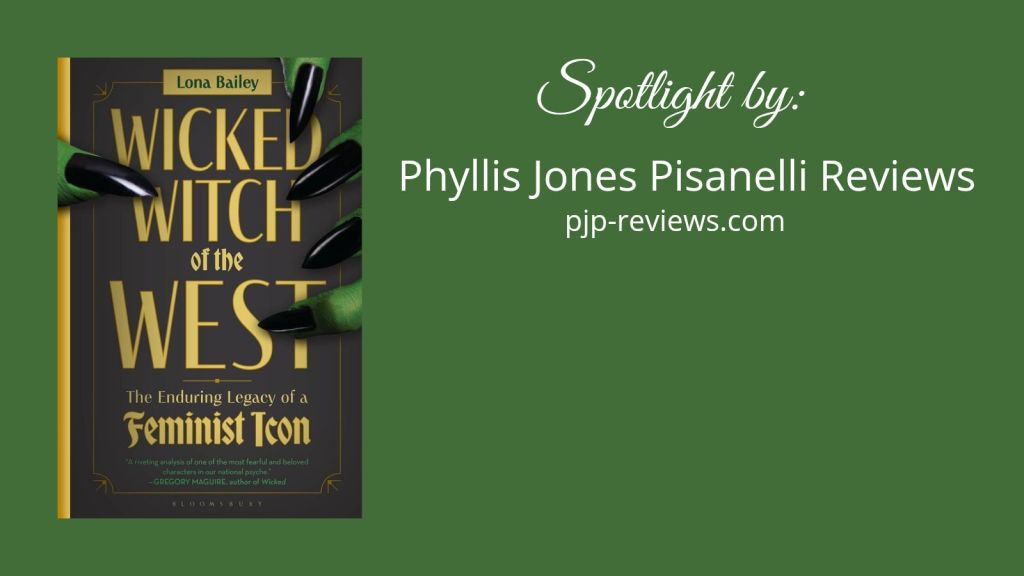
For generations, the Wicked Witch of the West has stood as one of fiction’s most iconic figures—a shadowy presence both feared and fascinating. In The Wicked Witch of the West: The Enduring Legacy of a Feminist Icon, Dr. Lona Bailey reclaims this figure from the realm of villainy and reintroduces her as a defiant emblem of womanhood, misunderstood by the very culture that created her.
Bailey’s exploration moves beyond Oz’s yellow bricks and into the social fabric that has defined—and confined—powerful women for more than a century. From L. Frank Baum’s original vision to modern reinterpretations like Wicked, Bailey illuminates how the Witch’s story has mirrored women’s evolving battles for respect, equality, and voice. Each adaptation, she argues, reveals something about the world’s comfort—or discomfort—with women who dare to wield influence. Richly researched and beautifully written, the book examines how this so-called “wickedness” is in truth a reclamation of autonomy, making the Witch a living metaphor for every woman who has ever refused to shrink herself.
EXCERPT:
It’s quite impossible to explore the icon of the Wicked Witch without acknowledging Margaret Hamilton’s unforgettable portrayal of the character, as she is widely credited with introducing her to the world in a way that has captivated audiences ever since. Was it the green skin, broom, cackling laughter, exaggerated hook to her nose, or sharp-tongued quips that embedded her into cultural consciousness? Perhaps all of those things and more initially made the world fall fast and hard for the fiendish character, but only in the context of Margaret Hamilton’s simply splendid portrayal.
“I was walking down Fifth Avenue in New York not long ago when a nice-looking young man called to me. ‘Miss Hamilton,’ he said, ‘you don’t know me, but I know you. You scared the pants off me when I was a little boy,’” Margaret Hamilton recalled.1 The barely five-foot-tall Margaret “Maggie” Hamilton has managed to terrify millions for more than eighty-five years in her characterization of L. Frank Baum’s Wicked Witch of the West. What began as a fairly one-dimensional antagonist with few descriptives beyond her general reputation for wickedness, was suddenly and frighteningly brought to life thirty-nine years after she was penned in Baum’s book and the legend of The Wizard of Oz truly began. In following suit with what “that little animation company” Walt Disney did in the successful film adaptation of the children’s fantasy story Snow White and the Seven Dwarfs, MGM bought the rights to adapt Baum’s novel The Wonderful Wizard of Oz to brilliant Technicolor in 1938. The demigod of MGM, Louis B. Mayer, purchased the book’s rights in the fall of 1937 upon the suggestion of Mervyn LeRoy. Mayer saw grand potential in a musical version of the children’s novel and with LeRoy and Arthur Freed on board, revisions toward final production were initially promising. The script went through a merry-go-round of revisions from its initial draft to its on-screen presentation with cuts, edits, rewrites, and additions from legions of hired, fired, and rehired writers.
The only mainstays were the leading cast—well, sort of. Judy Garland was cast as Dorothy, Frank Morgan as the Wizard (and several other supporting roles), Ray Bolger as the Scarecrow/Hunk, Bert Lahr as the Lion/Zeke, Jack Haley as the Tin Man/Hickory, Billie Burke as Glinda, and Hamilton as the Wicked Witch of the West/Miss Gulch.
Originally, actress Gale Sondergaard was cast as the Wicked Witch, but being a bit too glamorous for such a haggy and undesirable part, Sondergaard withdrew from the production and Hamilton was offered the role just three days before filming began. Hamilton had appeared in several films for MGM by 1938, and with her distinct features and knack for spinster supports, Director Victor Fleming thought she was a natural choice for the queen of mean.
Whether or not Hamilton knew of Matilda Joslyn Gage as “the woman behind the curtain” of Baum’s novel, in her portrayal, she creatively matched the feministic intentions of the original story’s creator. While the Technicolor Wizard of Oz fostered the stereotypical image of what “witches” were believed to look like in the 1930s.
Witches were generally considered sallow, sexless figures whose rebellious and/or peculiar behavior had caused them to be ostracized by the general public. One early exception to this is Edmund Spenser’s The Faerie Queene (1590) with the character of Acrasia, the enchantress who uses her beauty to seduce and corrupt knights. Unlike the longstanding, older, and malevolent image of witches, Acrasia is described as physically alluring and beguiling, using her appearance and charm as weapons to achieve her goals. Though still a nonconformist in Spenser’s story, Acrasia’s beauty masks her dangerous nature, a theme that has been echoed in later depictions of witches in literature and folklore, though most classic literature purports “witch” to be synonymous with “ugly.”
Nonconformist characteristics (described in horrid terms) usually included degrees of unsightly yellow or red complexions, unkempt, stringy hair, exaggerated facial features, and of course, warts. For example, William Shakespeare’s witches, the “Weird Sisters” in Macbeth, are described as dirty, haggish rebels who live separately from society and possess not only mystical powers but also distinctively masculine features such as beards. Any beauty that was ascribed to a witch before the postmodern reinvention of her image was usually only a magical cover for her “true” haggish nature, which she ruthlessly used to further her evil agenda. For better or for worse, MGM began the reinvention process of the witch, and Margaret Hamilton’s face was the canvas on which they painted—literally. With a hooked nose, green skin, pointy chin, crystal ball to spy on her enemies, and dressed all in black with a flying broom, Hamilton herself subtly fostered a more progressive approach to villainy in that inch of redemption she gifted the character through her own touch of feministic essence despite her convincing malevolence on screen.
Contrary to most villainesses in early literature, film, and television, the Wicked Witch was not a masculine character. Perhaps we wouldn’t call her “pretty” in the green paint and prosthetics, but still Hamilton brought a subtle, yet undeniable femininity to the role that changed the “look” of a “witch” in the general sense. The paradox of Hamilton’s portrayal in such a traditional era was that she brought both femininity and feminism to the characterization. Billie Burke, on the other hand, certainly brought femininity to “Good Witch Glinda,” and her delicate, docile characterization stuck closely by Baum’s original non-feministic “Good Witch.” Burke seemed to naturally exude a dainty energy and sense of glamour as Glinda, which is also what the role required, but as far as MGM was concerned, Margaret Hamilton’s subtle artistic strokes of feminism weren’t of importance just so long as she, as the “bad one” was scary and not too “pretty.”
From Lona Bailey:
While researching this book, I discovered just how much world history has culminated to give us what we now recognize as the icon of the Wicked Witch. Her evolution was absolutely fascinating to trace. We tend to think of witches in fiction as timeless villainesses who have “always” existed in a fixed way, but that couldn’t be further from the truth. The figure of the witch reaches back to ancient civilizations—where she could be feared, revered, or misunderstood—and over the centuries she has been shaped by religion, politics, gender norms, and folklore. What struck me most was how, in the last hundred years especially, the witch has transformed from a symbol of evil into one of independence and feminine strength.
That journey mirrors so much of women’s history itself: the push from suppression to empowerment, from being silenced to reclaiming voice and agency. Even on the set of The Wizard of Oz, you can see this cultural tension at play in the contrast between Margaret Hamilton’s “wicked” witch and Billie Burke’s “good” one—both the characters and the actresses were shaped by typecasting, the misogynistic “old studio system,” unrealistic beauty standards of the Golden Era of Hollywood, and class perceptions of their time. This was heartbreaking, yet important for me to better understand, because we—so many decades removed from their era—tend to see everyone in films like The Wizard of Oz as glamorous stars, but in real time, there were studio system biases that caused great woundedness for many like Hamilton who dared to be different. The harmful stereotyping in bygone eras not only shaped the icon of the Wicked Witch, but actresses like Hamilton who portrayed her.
Digging into these layers made me realize that the Wicked Witch isn’t just a fictional figure, she’s a cultural mirror. Every generation redefines her based on what it fears—or celebrates—about powerful women. That discovery gave the project a deeper meaning and made me fall even more in love with her story.
Questions & Answers:
Writing Process & Creativity
How did you research your book?
I dove deep into everything from MGM archives to feminist theory journals, historical folklore books, and even old fan magazines. I wanted to understand not just the Wicked Witch herself but how audiences across decades have reacted to her and why. It was part film history, part cultural detective work and I loved every minute of it!
What’s the hardest scene or character you wrote & why?
Honestly, there really weren’t many, if any, “hard” parts to write for this book—it was fun and engaging from start to finish. Every chapter felt like uncovering a new layer of the Witch’s legacy, and the deeper I went, the more fascinating she became. It was one of those rare projects that energized me instead of exhausting me.
Where do you get your ideas?
Usually from questions or topics of intrigue that just won’t leave me alone. With this book, it started with, “Why do we still fear the Witch, but secretly root for her too?” That curiosity turned into a full-blown exploration of power, femininity, and legacy and what perfect timing with the film adaptations of Wicked!
What sets your book apart from others in your genre?
I think this is one of the first books about the Wicked Witch herself not just in the context of film history, but in a broader cultural conversation. I have tried to blend Hollywood storytelling with feminist analysis, so readers get equal parts behind-the-scenes entertainment lore and what-does-this-say-about-me insight.
What helps you overcome writer’s block?
When writer’s block hits, I get up and move—I take a walk or slip into a good young adult fiction I enjoyed when I was younger (I’m a huge Nancy Drew fan!). Something about the rhythm of walking or the familiar creative tangles of a Nancy Drew or Goosebumps story helps the next line find me instead of the other way around.
What’s your favorite compliment you’ve received as a writer?
Several people over the years have told me after reading a biography I wrote of their loved one— someone I never had the chance to meet in life – that it felt as though I had known them personally. That’s one of the greatest compliments I could ever receive as a researcher and writer. It tells me my research was thorough, my interpretation true to the person, and that I succeeded in bringing their spirit to life on the page.
Your Writing Life
Do you write every day? What’s your schedule?
Like many writers, I usually write something every day, even if it’s just a few paragraphs or some notes. I’m most creative in the mornings, so I like to get my coffee, open my laptop, and dive right in when I can. Some days it’s research, other days it’s full-on storytelling, but luckily I enjoy both.
Where do you write—home, coffee shop, train?
Mostly in my home office—it’s my creative haven. I’ve built a cozy writing space that feels both peaceful and inspiring, filled with books and old Hollywood memorabilia that keep me grounded in the era I often write about.
Any quirky writing rituals or must-have snacks?
I always have my furry sidekick, Penny the morkiepoo, curled up on my desk as my “lucky Penny.” She’s my little muse. I also choose a new candle for each book I write—a scent and name that somehow connect to the story at hand—and I burn it every time I work on that project. It’s my way of setting the mood and signaling to my brain, it’s time to write.
Behind the Book
Why did you choose this setting/topic?
I’ve always been fascinated by Margaret Hamilton’s portrayal of the Wicked Witch, and it occurred to me a couple of years ago that she did not have a full-length biography. After some preliminary research, I realized the potential for combining a bit of Hamilton’s story into the larger story of the Wicked Witch. The Wicked Witch of the West is so much more than a villainess—she’s a mirror of how women’s power and independence have been viewed through time, which are always topics of importance. Writing this book gave me the chance to explore her evolution from fearsome figure to feminist icon and the timing of the Wicked films was “spookily” perfect.
If your book became a movie, who would star in it?
Though nonfiction academically postured books are sometimes harder to adapt to film, if it were to happen I would love to see someone like Sigourney Weaver or Anjelica Huston bring the Witch’s complexity to life—they both have that rare ability to blend elegance, strength, and mystery. Of course, a musical cameo by Kristin Chenoweth or Cynthia Erivo would be the perfect nod to the Witch’s modern legacy!
Which author(s) most inspired you?
I’ve always loved classic literature—there’s something timeless about the way those writers captured human complexity. Faulkner and Tennessee Williams are two of my favorites for their depth and southern sensibility, but I also adore Kate Chopin and Shirley Jackson for the way they explored women’s inner lives with such courage and nuance. Their influence definitely weaves its way into how I approach character and theme in my own writing.
Fun & Lighthearted Qs
What’s your go-to comfort food?
Coffee. Does a drink count?
What are you binge-watching right now?
Judge Judy. It’s been my go-to comfort show for decades!
If you could time-travel, where would you go?
I’d go straight to 1940s Hollywood to see the Golden Age in full swing with the studio sets, radio broadcasts, and all that behind-the-scenes glamour I’m always writing about. I would also sit outside Clark Gable’s dressing room for as long as it took to meet him!
What 3 books would you bring to a desert island?
The Bible, The Great Gatsby, and A Light in August.
What’s something that made you laugh this week?
I’m a big vaudeville fan, so I always laugh when I catch glimpses of that kind of comedy in everyday life. The other day, I looked out my home office window and saw a rather small pickup truck slowly rolling down the road with a huge pile of mismatched chairs rounded over to the sky in the back. Miraculously, nothing fell off, but the whole scene looked like something out of a Three Stooges episode, and I couldn’t help but laugh while I took a picture of it.
ABOUT THE AUTHOR:

Dr. Lona Bailey is a decorated biographer and historian whose work honors women who helped shape Hollywood’s Golden Age but were often left in the footnotes of history. Her acclaimed books—Uncredited, Voice of Villainy, Mrs. Radio, and The Wasp Woman—give voice to the silenced and offer an empathetic lens on fame, artistry, and identity. With a PhD and experience as a therapist, Bailey brings psychological depth to her storytelling, revealing not just the facts but the humanity behind each life. Her Voice of Villainy biography was an award-winner in 2023, earning both international and national honors. Discover more of her work on her website or connect on Facebook.
Amazon: https://amzn.to/4nHUMH4
Goodreads: https://www.goodreads.com/book/show/233812615-wicked-witch-of-the-west
 Phyllis Jones Pisanelli Reviews