Genre: Psychological Thriller Release Date: January 6, 2026
REVIEW:
Audrey J. Cole has brought us another Psychological Thriller that will keep you on the edge of your seat. If you have followed me for a while you know that this is one of my favorite genres and Ms. Cole is on my list of favorite authors. I can’t seem to pick just one. There are so many authors and genres to choose from.
If you like Psychological Thrillers this one should be on your to be read list if you haven’t read it already. It takes place in two different time periods with the same friends. These girls have been friends for many years. The most recent time period is recent time and the older one is when they were in high school. They all have different lifestyles now and aren’t necessarily close. Now they are going on a trip. The Trip. It takes place on a sailboat so you know they are going to be in close proximity. Then the fun begins…
You will like some of the characters and suspect all of them at one time or another. My mind was rolling in circles trying to figure out who was behind everything that was going on. There are those that you will suspect all the way until the end.
If you like Psychological Thrillers and if you haven’t read Audrey J. Cole, what are you waiting for? You must put this on your nightstand. Take caution, it might cause you a couple of sleepless nights! Until next time…Happy Reading.
Don’t forget to support the authors you read by leaving a review. Even a few words help!
I received a complimentary copy of this book from the author. The opinions I have expressed are my own and I was not required to write a review. I am disclosing this in accordance with the Federal Trade Commission’s 16 CFR, Part 255.
SYNOPSIS:
From USA Today bestselling author Audrey J. Cole comes a locked-room thriller at sea about image and influence, guilty secrets that won’t sink, and the lies we cling to in the storm.
A luxury sailing trip is the perfect escape from Palmer’s shattered marriage. Until the Pacific Coast cruise—a chance for old friends to mend old wounds—descends into a harrowing fight for their lives.
Twenty years ago, the five of them were inseparable. But after a rafting accident their senior year, only four of them returned. Volleyball captain Courtney’s body was never found. And their lives were never the same.
Now Palmer, her ride-or-die Beth, and home renovator Emma are on an all-expenses-paid trip with mega-influencer Gigi. But a mysterious note and a violent storm soon push them dangerously off course. The radio’s down, the captain’s missing, and the first officer’s woefully inexperienced. And in a chilling echo of the past, Gigi gets swept away. Perhaps on purpose.
Someone doesn’t want them to make it back. Palmer’s not sure who to trust, but she knows the truth lies in the murky depths of what really happened that day on the river.
ABOUT THE AUTHOR:
Audrey J. Cole is a USA TODAY bestselling thriller author. She resides in the Pacific Northwest with her two children. Before writing full time, she worked as a neonatal intensive care nurse for eleven years. She’s also a pilot’s daughter.
Sign up for her mailing list at https://www.audreyjcole.com/sign-up to receive free bonus content, promotions, and new release updates. Audrey can also be found on
Set against a story shaped by loss, longing, and unexpected possibility, One Alpen Day by Michele Davenport-Dutton centers on two people whose lives intersect at a moment when both are quietly hoping for something more than what they have known so far.
Angela Sutton has returned to the place she once called home after a series of personal losses leaves her rethinking everything she imagined for her future. Newly divorced and grieving multiple pregnancy losses, she begins helping her aunt run the family bakery, settling into a slower life shaped by routine and reflection. Her days take an unexpected turn when Mason Glade, a well-known Hollywood actor, walks into the bakery.
Mason arrives carrying his own burdens: a strained marriage to his estranged wife, Camila, whose struggles with alcoholism have spilled into the public eye, and a fierce desire to protect his two young children from the fallout. With Camila entering rehab, Mason takes his children and their nanny far from familiar pressures, hoping distance will offer clarity. As Angela grows closer to Mason and his children, questions emerge about timing, trust, and whether love can take root amid unresolved ties and uncertain futures.
EXCERPT:
Angela moved back to Grainau last year after Uncle Karl died from a massive heart attack at the age of seventy-six, leaving Aunt Terese to tend to their forty-year-old bakery alone. Around the same time, Angela had gone through a bitter divorce from her husband, Nick Sutton Jr. after three years of marriage. He had carried on his father’s legacy as a business mogul in L.A. Nick Jr. was in the Garmisch/Grainau area for business and it was there he met Angela at the bakery four years ago. He had swept her off her feet and dragged her to L.A where they were married a few short months later.
The Alpen Bakery, as named by Aunt Terese and Uncle Karl, carried an assortment of breads, rolls, sheet cakes and pastries. Bread is to Germans what cheese is to the French. There are more than four hundred types of bread in Germany. And, a good bakery such as Angela’s aunt and uncle’s, stocked at least ten to twenty kinds of breads, ten kinds of rolls and an assorted variety of sheet cakes and various pastries, including Aunt Terese’s delectable Apple Strudel. Plus, it was said by locals that they made the best cappuccino in town.
Angela was cleaning and dusting all the pictures and paintings displayed in the bakery, over the empty tables when she heard Aunt Terese yell.
“Oh, dear! Somebody left their wallet on the counter!” She looked inside to see if she could find identification. She peered sideways at Angela and batted her eyelashes. “Mason Glade,” she said. Angela’s stomach turned in knots. Just hearing his name made her break out in goosebumps.
“He’ll be back soon enough,” and with that, Aunt Terese closed the wallet. “He won’t get far without his wallet,” she quipped enthusiastically.
Angela went back to spritzing glass cleaner on the glass covering the Neuschwanstein picture which had smudges all over from people, mainly kids, touching it. It’s King Ludwig’s most beautiful and prized castle. The rest of the walls displayed photos of Garmisch-Partenkirchen and the ski jump, where the 1936 Winter Olympics were held. Both Aunt Terese and Uncle Karl’s parents attended, as it was a huge event. Uncle Karl was just a baby at the time. Next to the Olympic pictures were framed news articles and interviews from that event.
After she dusted the painting of the Zugspitze, Germany’s tallest and most glorious mountain, which has her town of Grainau at its base, she went back into the kitchen and washed her hands.
Aunt Terese saw Mason walking outside the front window and quickly shouted, “There he is, Angela!”
Mason opened the door and walked up to the counter. “Hello, excuse me, but I believe I left my wallet here, or I’m really hoping it’s here.” Aunt Terese picked it up from behind the counter and handed it to him. Mason was grateful he didn’t lose it. “Oh, you don’t know how scared I was, thinking I had lost it. Thank you so much,” he said, a nervous relief in his tone. At that moment, Angela walked out from the back and Mason said, “Wait, aren’t you Angela?” He pointed over to the rear corner where he remembered seeing her choking.
Angela’s insides did a cartwheel. She couldn’t believe he remembered her name from when Aunt Terese shouted it earlier, asking if she was okay.
Angela cleared her throat. “Yes, Hi, I’m Angela.” She reached out her hand and Mason shook it.
“Hello Angela. It’s very nice to meet you. I’m Mason, by the way. You work here?”
Her hands were clammy and sweaty from her nerves. “Yes, this is my Aunt Terese and Uncle Karl’s bakery. They’ve owned it for forty years now.”
ABOUT THE AUTHOR:
Michele Davenport-Dutton has loved reading since childhood and was once the top reader at her Montessori school in Garmisch, Germany. A lifelong fan of heartfelt love stories with happy endings, she finally brought her own story to the page with this debut novel. Michele earned her bachelor’s degree in Business Management from CSUB before putting her career on hold to raise her family, spending nearly 30 years as a stay-at-home mom. Now fulfilling a long-held dream of becoming an author, she lives in Shafter, California, with her husband, Chris. Together they have eight adult children and seven grandchildren, with hopes for many more. Visit Michele on Instagram.
It was a cool, crisp spring morning in Garmisch-Partenkirchen, Germany, in 1974. I was a cheerful five-year-old girl, holding my Opa’s hand and skipping along the sidewalk to keep up with his quick pace. We were hurrying to the station to watch the trains come and go, one of Opa’s favorite hobbies.
The recent rain left a shiny gloss over the cobblestone road, making the stones look like individual turtles hiding in their shells. As the stores prepared to open, I looked up at the balconies where many shop owners lived. High above, I saw an elderly woman with gray hair and a red scarf. With a large green watering can in her wrinkled hand, she quenched the thirst of a window box filled with vibrant red, white, and pink geraniums.
When we arrived at the station, Opa began singing the song he taught me: “Eisenbahn, Lokomotive, wer kein Geld hat, darf net mit.” Translated, it means, “Steel train, locomotive, whoever has no money cannot come along.” While the German lyrics rhyme, I always found the sentiment a bit harsh and felt pity for those who couldn’t afford a ride.
As Opa enjoyed a cigarette, I practiced flips on the nearby bars. Whenever he saw me, he would yell, “Ach Gott, Mimi! Du fällst runter!”—”Oh God, Mimi, you will fall down!” I would study him like a Monet or Van Gogh painting. He was a short, stout, yet well-dressed man who wore his grey feather hat with pride. His face was perfectly round, like a chef’s potato dumpling, and his large, steel blue-grey eyes always looked peaceful.
Opa wore Old Spice aftershave, and to this day, that scent instantly brings back his memory. Our walks to the train station were always an adventure, and they will forever be embedded in my heart.
My story takes place in the beautiful, scenic Garmisch/Grainau area of Germany and although the love story is fictitious, the setting holds fond memories for me as I lived in Garmisch as a little girl. Garmisch was my home, a special place with my loving family. I often reflect on the times walking to the train station with my Opa Max and below is a special memory from that time. I had to include Opa’s life events in my novel and share it with the world.
QUESTIONS & ANSWERS:
What’s a detail, theme, or clue in your book that most readers might miss on the first read—but you secretly hope someone notices? Mason’s estranged wife always wears gold- glittered costumes for her rodeo shows. Angela, the protagonist, has Emerald green eyes. The last line of the book has Mason thinking, All that glitters isn’t gold. All that glitters is Emerald green.
When did this story or idea “click” into place for you—was there a single moment you knew you had to write it? My sons went on a weekend Boy Scout camping trip with their dad. He took our five-year-old daughter with them. I was all alone at home (a rare treat) and thought, “I want to write a book.” I grabbed my notebook and a pen and the characters just came to me. The setting unfolded and yet it took years in the making of writing this novel, having been a stay-at-home mom was my top priority. I’m happy to see my little novel finally come into fruition.
Which character or real-life person surprised you the most while writing this book, and why? Opa, my grandpa. Although he passed on many years ago, at the ripe old age of 93, every time I read the last two chapters of my book pertaining to him, I cry. No tears in the writer, no tears in the reader, right?
If your book had a soundtrack, what three songs would be on it and what scenes or moments would they pair with? “Everything that Glitters is Not Gold,” (sung by Mason, while he’s strumming his guitar in the alps. That song hits me hard) “Edelweiss” and “The Sound of Music,” because of the majestic alps in the background.
What’s one belief, question, or emotional truth you hope readers carry with them long after they finish your book? Finding healing from loss. Love and connection help people grow. Love is better the second time around. If your protagonist (or the central figure in your nonfiction) could give the reader one piece of advice, what would it be? Love triumphs over fear. Love conquers all.
What real-world place, object, or memory helped shape a key element in your book? The setting in the Garmisch/Grainau is where I lived as a young girl. My Opa would hold my hand as I skipped to the train station where we’d watch the trains coming and going.
What’s something you had to research, learn, or experience to write this book that genuinely shocked you? Researching miscarriages and how it affects women deeply, the trauma they endure.
If your book were invited to join a shelf with two other titles, which ones would make you happiest—and what would that shelf say about your story? Jane Porter’s Christmas at Copper Mountain and Julie Olivia’s If it Makes You Happy. The shelf would say “Come over, stay a while. Let me take you on an armchair adventure you won’t want to miss.”
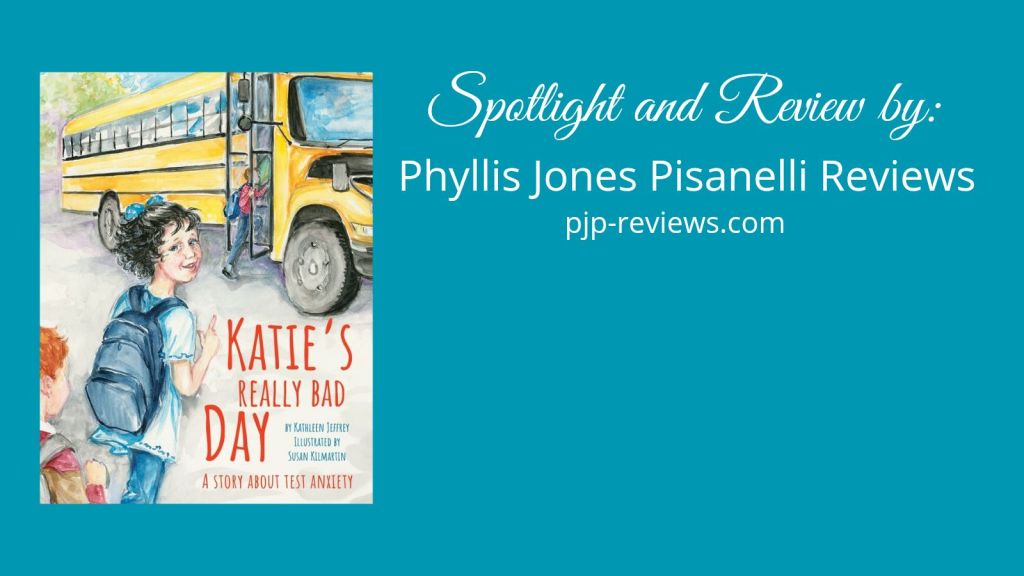
Some days unfold exactly as planned, while others take an unexpected turn. Katie’s Really Bad Day: A Story About Test Anxiety by Kathleen Jeffrey, illustrated by Susan Kilmartin, explores what happens when internal pressure overwhelms a child who usually feels prepared.
Katie enjoys learning and usually approaches her day with enthusiasm, but test days stir up uncomfortable feelings she struggles to control. During a spelling test, her anxiety becomes overwhelming, making it hard to think clearly or stay focused. In a moment of panic, Katie reacts in a way that draws attention and leaves her feeling embarrassed.
With thoughtful guidance, Katie begins to learn why her body reacts the way it does under stress. She is introduced to calming strategies that help her slow down and refocus. As she practices these tools, Katie gains confidence in her ability to manage anxious moments. The story gently shows how understanding and practical techniques can transform a stressful situation into a learning experience.
MY REVIEW:
I was offered the chance to review Katie’s Really Bad Day by Kathleen Jeffrey, a children’s book. I decided I would because many of my friends and followers have young grandchildren. I kind of wished this kind of book was available when I was a young child.
Kathleen Jeffrey has written an important book for parents and children. She has a wonderful Illustrator which takes this book up another notch. She is Susan Kilmartin. I especially enjoyed her beautiful illustrations.
I highly recommend Katie’s Really Bad Day written by Kathleen Jeffrey and Illustrated by Susan Kilmartin. In my opinion, this book can be a great learning tool to teach coping skills and other children how to be concerned and help their friends.
Please remember to support the authors you read by leaving a review. Even a few words help.
I received a complimentary copy of this book from the author. The opinions I have expressed are my own and I was not required to write a review. I am disclosing this in accordance with the Federal Trade Commission’s 16 CFR, Part 255.
ABOUT THE AUTHOR:
Kathleen Jeffrey is an author of children’s picture books, fulfilling her mission to create stories that shine with love, light, spirit, truth, and joy—helping children navigate life’s challenges, explore big emotions, and grow with courage, kindness, and wonder.
I was an anxious child in school. Eventually this anxiety developed into test anxiety that stayed with me through college. It didn’t matter if I knew the answers, the panic still set in!
Many children experience anxiety in school for various reasons. In researching for this book, it was wonderful to learn of the many resources and tools available today for teachers to help their anxious students. Some students are very good at concealing their test anxiety feelings and may suffer needlessly while also thinking they are the only ones. In addition, test anxiety can lead to a pattern of underachievement.
I hope Katie’s story will help children identify their own anxious feelings, know that they are not alone and encourage them to tell their teachers and caregivers what is going on before their anxiety leads to “A Really Bad Day!”
Who and what ultimately inspired you to become a writer?
About 23 years ago, after my dad passed away, I had a divine inspiration to write a spiritual children’s picture book. I started planning, thinking, praying on it, but the timing was never right to dig in and get it done. Life was busy, my children were young, and I worked full time.
Eventually I left my 28-year media sales career and ended up working in the bookstore at Glastonbury Abby, a benedictine monastery. Researching and buying books for the store was fun, inspirational and kept my book idea alive. Finally, I wrote a very long manuscript. Through working with critique groups, I concluded it was really two books. Out of that came Katie’s Really Bad Day. The next book is also about Katie and relates to my original inspiration for a spiritual picture book.
Between journaling for the past 23 years, joining the Society of Children’s Books Writers and Illustrators (SCBWI) to learn how to write a picture book, and writing poetry during covid, I was finally ready to leave my twelve-year bookstore adventure and get on with writing and getting the book published!
QUESTIONS &ANSWERS:
What’s a detail, theme, or clue in your book that most readers might miss on the first read—but you secretly hope someone notices? Empathetic, concerned faces of Katie’s teacher, Mom & Dad, and her classmates when Katie is upset. No one is making fun of her.
When did this story or idea “click” into place for you—was there a single moment you knew you had to write it? During critique group sessions with a long manuscript, I discovered I actually had two books to write. The first became Katie’s Really Bad Day: A Story About Test Anxiety, to identify Katie’s character with school & test anxiety, which is based on my personal story I had to tell for authenticity. The second book will feature Katie once again and will be illustrated sometime this year.
Which character or real-life person surprised you the most while writing this book, and why? Katie’s sidekick Finn turned out to be quite the entertaining cut up as well a very concerned and empathetic friend.
If your book had a soundtrack, what three songs would be on it and what scenes or moments would they pair with? “Inside Out” by Michael Giacchino, (From joyful school yard to Katie’s sudden test anxiety.) “When I Breathe” by Stephanie Leavell (Learning belly breathing with Miss Julie and later with the class.)“When I’m Nervous” (A song for kids about overcoming anxiety.) Overall story wrap up. Would play at the end of the book.
What’s one belief, question, or emotional truth you hope readers carry with them long after they finish your book? That many students are anxious in school or before tests so you are not the only one. Because you are anxious before a test does not mean you are not smart or capable.
Tell us about a moment during the writing process when the story (or message) took an unexpected turn. I was determined to have Mom take Katie into school the day she did not want to go because that was my personal experience. Through teacher critique partner advice and their experiences with children in today’s classrooms, I realized Katie would have to take the bus, work through it and tell Miss Julie what was going on.
If your protagonist (or the central figure in your nonfiction) could give the reader one piece of advice, what would it be? Lots of kids get anxious before tests! Let your teacher and caregivers know when you are anxious. There are always solutions!
What real-world place, object, or memory helped shape a key element in your book? My second grade elementary classroom and getting caught having scratched on my varnished desk was a deep rooted memory. A boy noticed it and yelled out to the teacher. She was very angry and scolded me in front of the class. I was so embarrassed I refused to go to school the next day so my mom had to bring me in and talk to the teacher.
What’s something you had to research, learn, or experience to write this book that genuinely shocked you? Through my research on childhood, school and test anxiety, I learned test anxiety can start as early as second through fourth grade and may lead to underachievement. Between this research, writing my bio, interviewing my mom, older sister, adult neighbor and childhood classmates, I was able to make connections. The seeds of my overall school anxiety started with significant separation anxiety my first three weeks of kindergarten. By fourth grade my overall school anxiety did lead to test anxiety and eventually underachievement. Anxiety triggers fear and panic which makes it hard to concentrate when learning new concepts or taking notes while trying to keep up with the teacher or actually taking a test.
If your book were invited to join a shelf with three other titles, which ones would make you happiest—and what would that shelf say about your story? Wilma Jean The Worry Machine by Julia Cooke (Classic, Funny, Popular)
The Big Feelings Book for Children: Mindfulness Moments to Manage Anger, Excitement, Anxiety, and Sadness by Sharon Selby MA (Respectable, Useful, Popular)
Alexander and the Terrible, Horrible, No Good, Very Bad Day by Judith Viorst & Ray Cruz Total Classic! (Happiest)
Genre: Men’s Adventure Fiction Release Date: August 20, 2025
INTRODUCTION:
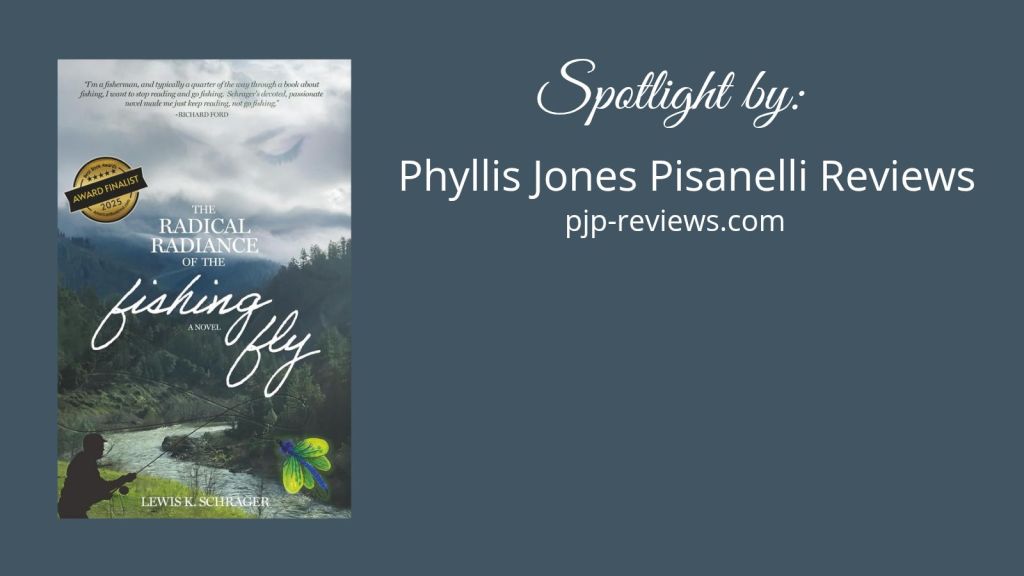
David Nichols arrives in Alaska grounded in logic, not instinct. In The Radical Radiance of the Fishing Fly, Lewis K. Schrager places a methodical mind into an unforgiving environment that exposes emotional truths long kept in check.
When rational certainty collides with emotional unpredictability, transformation becomes unavoidable. David Nichols’ structured life begins to shift after his brother Larry faces cancer. During treatment, Larry finds endurance through the creation of fishing flies and imagined waters, sustaining himself through uncertainty.
After recovery, Larry invites David on a fishing journey that tests both their relationship and David’s reliance on control. Immersed in a group driven by shared passion, David struggles to connect as unresolved conflicts between the brothers surface. He is drawn to Kathy Sands, another member of the group whose personal grief mirrors the emotional weight of the journey.
As the experience deepens, a covert nighttime expedition fueled by revenge forces David to confront the limits of reason, reshaping his understanding of loyalty, fear, and emotional restraint.
EXCERPT:
From Chapter One
I pulled out of the underground garage onto Wisconsin Avenue, then down the ramp heading east on the Washington Beltway. Rays of the rising sun glowed orange in a far-off bank of clouds. Gray banks of night fog, exhaled from dying creeks and streams entrapped within the urban sprawl, drifted over the roadway bridges before dissipating as rising haze over the slim remains of vestigial marshland. I turned onto I-95 North, speeding past countless semis parked close along the shoulders of the highway, red running lights blinking crazy in the half-light. I imagined the truckers awakening in their dark, coffin-like spaces, yawning and stretching and rubbing their eyes as they plan for another day bringing who-knows-what to who-knows-where.
Wondering where I was going.
Wondering why.
In fact, I knew. My destination on that steamy August morning was the Philadelphia airport, a rendezvous with my older brother Larry. In less than three hours I would be meeting him there. We would board our plane to Seattle, and then another to Anchorage, and then a third and a fourth, our destination somewhere in the Alaskan wilderness for a week of fly fishing.
The first rays of the freshly risen sun flared above the distant cloudbank. I squinted against the blinding glare, lowered my sun visor, fumbled with my sunglasses, and slipped them on. This was a bad idea.
I was nervous about spending this much time with Larry. Growing up, he was brash and loud, determined to be the center of attention. I was quiet, more than happy to disappear into the background, unnoticed and undisturbed. This worked out fine when we were apart. On the few occasions where we found ourselves thrown together, like at an occasional high school party, he’d notice my subtle signals of embarrassment at his behavior and would talk more loudly, act more wildly, dance more crazily, until I shrunk away into a kind of nothingness and headed home on my own. I could never even think of taking him on physically when he pushed me past my breaking point as he was taller and far stronger than I, and a champion wrestler as well.
I tried to convince myself that this fishing trip would work out fine. So much had changed since our high school days. Larry had become a successful businessman, having grown Leather and More, our father’s store in South Philly to three times its original size. He’d expanded the business, establishing a second store in the Mall at Short Hills, a prime shopping destination in the tony New Jersey suburbs just west of New York City. He’d married Tina Simons, a wonderful woman who gave him a couple of lovely daughters. He’d mellowed.
Besides, I realized that all this cogitation was irrelevant. Mellowed or not, I never would have agreed to go on this trip if not for Larry’s cancer
ABOUT THE AUTHOR:
Lewis K. Schrager is an author and playwright whose short fiction has twice been honored in the F. Scott Fitzgerald Literary Contest and has appeared in numerous literary journals, including South Carolina Review, Cottonwood, and Bryant Literary Review. His plays have been produced in Baltimore and St. Paul, and The Radical Radiance of the Fishing Fly is his first published novel. A graduate of Johns Hopkins University and the Vanderbilt University School of Medicine, Schrager has also spent much of his professional career in global health, serving as an HIV/AIDS researcher at the National Institutes of Health and as a vaccine developer focused on tuberculosis prevention. Visit Lewis at his website.
What’s a detail, theme, or clue in your book that most readers might miss on the first read—but you secretly hope someone notices? The importance of appreciating the humanity in “others”. Our society is currently terribly divided. The general discourse, running from casual posts on social media sites to the language of our country’s leaders, too often is overtly, aggressively, dehumanizing – and seems to be getting worse each day. The consequences can be grave, leading to bigotry, violence, and even killings. This wasn’t the case when I wrote the book, (I first drafted this in ~2005). The initial title of the book was The Secret River. When I discovered that there was a Booker Prize finalist book with this name, I decided to change the title. The current title unexpectedly brought to my mind a focus on how something like a work of art (in this case, expertly hand-tied fishing flies) that could be appreciated by persons across economic, educational, and socio-political backgrounds could serve to serve to bridge societal schisms and help us appreciate others as fully “human,” with many of the same desires, and fears, as we hold ourselves.
When did this story or idea “click” into place for you—was there a single moment you knew you had to write it? Great question – yes, there was such a moment. While this story is mostly fictional, the foundation is based in reality (as is true for most realistic, literary fiction, I think). My younger brother developed Hodgkin’s disease and was cured by a bone marrow transplantation. He was a passionate fisherman and, like the Larry character, tied beautiful flies while suffering through his transplantation, promising himself a trip to Alaska if he survived. He did survive, and invited me to go along, which I did, reluctantly. The “click” you refer to has to do with the circumstances surrounding the loss of his flies, and their subsequent recovery. This part of the book – how the flies were left behind in the Anchorage airport, how my brother went kind of crazy when he learned about this after we arrived in our distant village, how I came up with the story of one of the fishermen having a heart attack and needing the medicines left behind in his bag and threatened the airline with this, resulting in the delivery of his bag with his flies, and the bags of the other fishermen as well – actually happened. This was the “click.” The rest, particularly any of the story involving Kathy and Angie (there were no women on our trip) I mostly made up.
Which character or real-life person surprised you the most while writing this book, and why? This is a tough one. Many of the characters I named above progressed, and changed, along different arcs. In terms of who “surprised me” the most…perhaps Kathy. She was the empath; she sensed David’s inner turmoil and reached out to him, even though he was a stranger to her. Although she projected a personality of tolerance and accommodation, she also had a no-bullshit side of her. This came through early, when she had the guts to approach the hunters and tell them to put out their cigars in the hotel restaurant. This also came through when she decided to join Rick Garret, Zack, Butch, and Larry on their naked, midnight attack on the hunters’ camp – and demanded that David join her in this, saying that “sometimes revenge is therapeutic.” I really liked Kathy.
If your book had a soundtrack, what three songs would be on it and what scenes or moments would they pair with? Wow. I’m going to show my age here. 1. Muddy Waters – Rollin’ Stone (Catfish Blues) – pp. 68-69, when David and Kathy return to the hotel dining room and find all the fishermen sitting around, gloomy at the prospect of having to go on the trip without their equipment. 2. The Doors – Riders on the Storm – pp.201-203 – When the raiding party crosses the river in the moonlight to attack the hunters’ camp. 3. Crosby, Stills, and Nash – Wasted on the Way – p.212-213 – As they ride the last stretch of river, when everyone fishes in the warm sunshine. (I’d like to talk about more…)
What’s one belief, question, or emotional truth you hope readers carry with them long after they finish your book? That “people are people” – fundamentally with the same set of desires and concerns (broadly written) – living, loving, dying. It’s easy to forget this and be distracted by various influences to view others as threatening and different. It’s more difficult to appreciate the similarities in others – with the most fundamental one being their existence as a human being. Sometimes, something as simple as appreciation for radically radiant fishing flies can serve as a reminder.
Tell us about a moment during the writing process when the story (or message) took an unexpected turn. In an earlier draft, the scene on pp. 122-123, when David discovers Kathy bathing in the river and declines her invitation to join, had a different outcome. In the earlier draft, Kathy strode out of the water feeling angry, embarrassed, and hurt. It took about 40 pages of additional story for them to overcome this. Later, as I got to “know Kathy better,” I realized that this really wasn’t who Kathy was. I revised this and had her emerge from the river, nonplussed, and place a cold kiss on David’s forehead, before drying herself and getting dressed. This was the true Kathy…and also allowed me to cut 40 pages from the novel!
If your protagonist (or the central figure in your nonfiction) could give the reader one piece of advice, what would it be? Avoid making character assumptions of people based on social, economic, educational, and cultural differences; there may be more similarities between you and “the other” than you may realize.
What real-world place, object, or memory helped shape a key element in your book? The key place was the Alaskan wilderness, particularly the river that my brother and I traveled on and the little village in which we stayed (I call it Nalunaq; the actual village was Aniak) during the trip upon which this fictional story is based. I should add that the second real place is NYC in the wake of the 9/11 attack.
What’s something you had to research, learn, or experience to write this book that genuinely shocked you? Not a whole lot “shocks” me – but I guess I’d say the intensity of the fly fishing subculture. The guys who were on the trip took fly fishing VERY seriously – sometimes comically so (to an outsider, like myself). As an example, the scene on pp. 143-149, fishing in a driving cold rain at the “Moan and Groan Hole”, actually happened. Everything was real, up to the point where Russ slipped into the river. (I still get the chills thinking about that day.)
If your book were invited to join a shelf with three other titles, which ones would make you happiest—and what would that shelf say about your story? It’s going to be hard to answer this without sounding grandiose. Please cut me some slack here. 1. In Our Time (Ernest Hemingway); 2. The English Patient (Michael Ondaatje); 3. The Things they Carried (Tim O’Brien). Including these novels on the shelf (and I was pained to exclude books by Graham Green and Reynolds Price) is that writing an engaging, page-turning story, and writing a book that has a kind of rhythmic resonance to it, are not necessarily mutually exclusive. I’ve read compelling stories that “sound” like a stone knocking on a rotted log – these can do well in the marketplace, but I don’t enjoy reading them. Similarly, “writer-first” stories, which are all about the writing with no compelling narrative (and, sometimes, no narrative at all) also are not interesting for me to read; they seem pretentious and, if I’m being honest, arrogant. I have found the books I’ve listed extraordinarily beautiful to read, while they also pull me along in their engaging, powerful stories. I can’t say I’ve achieved this in Radical Radiance…but I’ve tried as best I could.








 Phyllis Jones Pisanelli Reviews