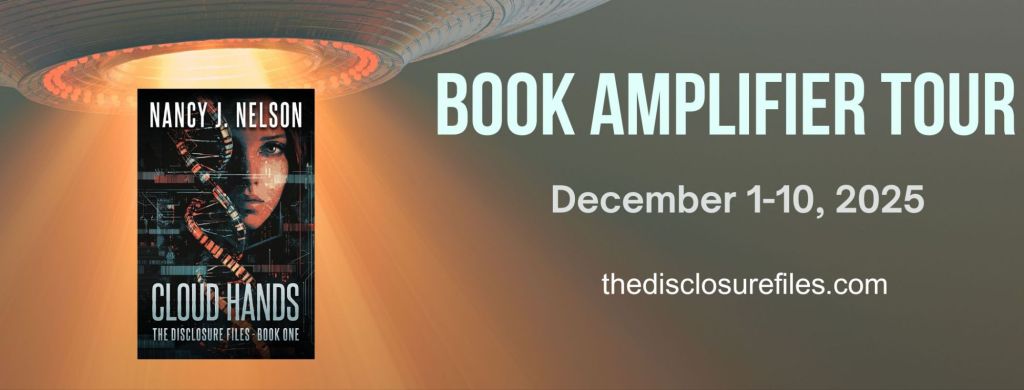
SPOTLIGHT: Cloud Hands by Nancy J. Nelson

INTRODUCTION:

In Cloud Hands: The Disclosure Files – Book One, Nancy J. Nelson begins with a diplomat stepping into what should be a quiet summer role, only to discover forces operating far beyond ordinary influence. The story unfolds at the intersection of global secrecy, emerging truths, and the quiet personal shifts that appear when long-kept structures begin to crack.
Vicki Heywood accepts a temporary position caring for the teenage children of a former professor, intending to recover from profound personal loss. What appears simple quickly reveals itself as the opposite. Vicki becomes aware of covert technologies, secret alien contact, and suppressed cures protected by a powerful corporate conglomerate known as the Partnership. As the stakes sharpen, she and the teens unintentionally uncover pieces of a larger conflict rooted in control, information, and hidden influence. Their efforts to understand what is happening place them at the center of a struggle where truth is dangerous and silence is strategic. As Vicki leans on her diplomatic training and the growing trust forming within the group, the story expands into broader questions about human potential, institutional power, and the possibility of a global awakening that redefines long-held assumptions.

EXCERPT:

Prologue

I used to think this story was about me. After all, isn’t everyone the star of their own life? It was only later that I realized we are all just bit players in some ever-repeating, cosmic pattern—a fractal pattern made up of love, hardship, desperation, joy, sorrow, and hope. Let’s never forget about hope.
—Victoria Heywood
Excerpt from address to the UN

There was a little cluster of forget-me-nots arranged in a vase on the table in front of Vicki. They had been Beth’s favorite flowers. Small and vibrant, so cute they made you smile. Just like Beth herself.

The waitress put a cup of coffee and a pastry before her, and the same in front of the man seated across the table. Kurt Martinsson—she had called him Professor Martinsson when he taught her senior business seminar a decade earlier—added some sugar to his cup before he took a sip. Well-built, dark hair with a touch of gray at his temples. He had aged well. His bespoke sports jacket, manicured nails, and expensive haircut suggested he was also doing well.

“It was kind of you to look me up, Professor Martinsson, especially after all this time. To be honest, I haven’t been getting out much.” She hadn’t been getting out at all. What was the point? Their parents had died in a car accident several years back, and now Beth was gone too. Per her request, there had been a closed casket; the chemo had ravaged her body and taken all her hair. There was no amount of makeup, no wig good enough, that could have fixed that.

“I heard about your sister, Vicki; I’m so sorry. I understand you left your position at the Department of State to look after her.”

Beth had argued against that. “I’m young and strong; I’ll be able to beat this—there’s no reason for you to leave the job you worked so hard to get. Mom and Dad were so proud that you became a diplomat—they wouldn’t have wanted you to give that up.” She had been wrong about being able to beat the cancer, but right that their parents had been proud. They would have been just as proud to see their youngest open up her own flower shop in a prime location in downtown Los Angeles.

“I took a year’s leave of absence when it became clear my sister’s illness was terminal. I have another four months before I either return to work or submit my official resignation.”

“So, you haven’t decided what you’ll do?” Professor Martinsson cocked his head to one side and looked at her. He had finished his croissant. She hadn’t even started on hers.

“No, I haven’t. Every time I start thinking about it…” She looked down at her coffee cup. It was too hard to think. Too hard to think about the future or anything else. She had officially shut down Beth’s flower shop the week after her sister died, although it hadn’t been in operation for a couple of months before that. At Beth’s urging, her two part-time employees had both found other jobs, and the shop sat dark and shuttered. She supposed she should do something—make arrangements to sell the building or rent it out —but she just didn’t have the bandwidth.

“I have an idea that might interest you. I need to do a lot of traveling over the next few months. My two children are more than old enough to stay home by themselves—Brad is sixteen and Jessica is twenty-two—especially since there’s household staff. But I’d feel better if someone was around to keep tabs on them specifically.”

He paused, then casually asked, “You do still have a Top-Secret Clearance, don’t you?”

Vicki looked up from her coffee and stared.

ABOUT THE AUTHOR:

Nancy J. Nelson is an author known for compelling narratives that explore mind-expanding questions about humanity’s next steps. Her most recent book, Cloud Hands: The Disclosure Files – Book One, has earned acclaim among readers drawn to thoughtful, visionary science fiction. Nelson comes into writing after 25 years as a diplomat with the U.S. Department of State and now lives in Los Angeles. Learn more through her website.

Amazon: https://bit.ly/480bFbm

Goodreads: https://www.goodreads.com/book/show/243373375-cloud-hands

GUEST POST:

I’ve actually seen UFOs!

Because I write science fiction, people often ask whether I believe in UFOs—and whether I’ve ever seen one. The answer to both is yes!

A few months ago, I paid $90 to attend a UFO-spotting event in Sedona, Arizona. We gathered in a park at the edge of town—ideal for sky-watching since Sedona is a “dark skies” community and the stars shine amazingly clear in the high desert. The organizer, Melinda Leslie, handed out military-grade night-vision goggles, told us where to focus—behind a mountain deep in Coconino National Park—and briefed us on what to expect.

The goggles intensified any light but didn’t provide clear outlines. With the naked eye, we could see nothing. Through the goggles, we saw shifting blobs of light—it was like looking at a drop of water through a microscope and seeing the swarming of amoeba.

Melinda explained how to identify what we were seeing by the strobe patterns: commercial planes flash differently from military ones. (There were plenty of military aircraft that night, but no commercial ones.) The lights weren’t satellites or drones, and she told us to watch for the steady, unblinking ones that suddenly “powered up,” glowing brighter for 15–30 seconds before dimming again, sometimes shifting to amber, red, green, or blue. Sometimes their movements made it look like whoever was flying them had figured out anti-gravity.

Sedona also has other strange stories. It’s a hiker’s paradise, but some hikers report being stopped by armed men in fatigues on certain trails—only for the same path to be clear the next day. Lockheed Martin recently bought a local cement plant and installed unusually tight security, and Blackhawk helicopters are often seen overhead.

Melinda believes all this points to a DUMB—a Deep Underground Military Base—in the area. She admits it’s hard to know whether these craft are extraterrestrial or advanced military technology, but at least three people have claimed to have worked there and claimed that humans and aliens operate side by side.

Personally, I hope that’s true. It would mean we’re not alone—and that the universe is full of other civilizations waiting to be discovered. But if it’s only the military, that means anti-gravity tech exists and is being kept from the rest of us.

Either way, it gave me great material. I even worked a secret underground base into my third book—so I’m pretty sure the $90 I paid is tax-deductible.

QUESTIONS & ANSWERS

Writing Process & Creativity

How did you research your book?
I didn’t research my book! I’m fascinated with the idea of aliens and UFOs, and have been following the research and news stories for a dozen years. It was logical to take these stories (and facts) and weave them into a science fiction series.

What’s the hardest scene or character you wrote—and why?
The most challenging character was Melly, the Galactic Federation representative from an insectoid species. She was much harder to write than other characters, even other alien characters, for a couple of reasons: 1) Melly comes from a species that has had interstellar capabilities for thousands of years. What’s the perspective of someone from a species with such a long history? I… don’t know. 2) Melly looks very different from humans. The other alien species in my series—the Suedes, the Pleiadians, and the Alpha Centaurians—all resemble humans to some extent, which made it easier for me to give them human-like emotions and desires. A praying mantis being who is eight feet tall? Not so much. 

Where do you get your ideas?
From real life. I got the diplomatic/government background from my 25 years working as a U.S. diplomat. The UFO and alien background are from current events, news stories, and reports from the last few decades. Why invent something when it’s right in front of you?

What sets your book apart from others in your genre?
I think my focus on Disclosure—the confirmation by world governments of an ET presence engaging the human race—is what makes my series unique in the science fiction genre. It’s not just the story—although having a good story is essential. I also explore issues such as the nature of power, who profits from keeping secrets, and how ordinary people can choose to walk down a path not approved by society.

What helps you overcome writer’s block?
My writers’ group! I started Cloud Hands two years before I moved to Los Angeles, but had only written three chapters. Joining my writers’ group—we meet once a week in a café—gave me accountability. The thought of going to a meeting and admitting I hadn’t written anything since the previous meeting was embarrassing. So I wrote. In six months, I had completed the first draft.

What’s your favorite compliment you’ve received as a writer?
It was a Kirkus review that described my story as “fresh, exciting, and often unpredictable.”

Your Writing Life

Do you write every day? What’s your schedule?
When I’m writing a book, I’ll write five hours a day, five days a week. But I’m retired—I realize that puts me in a privileged position.

Where do you write—home, coffee shop, train?
I write in a coffee shop because my L.A. apartment doesn’t have air conditioning. Also, being outside my apartment means I can’t distract myself by cleaning, cooking, reading a book from the shelf, etc. It’s another form of accountability.

Any quirky writing rituals or must-have snacks?
Coffee. Seriously, it’s the gift of the gods.

Behind the Book

Why did you choose this setting/topic?
Because I love the idea of aliens and UFOs, I love the idea that the universe is bigger and more awesome than we have been led to believe. 

If your book became a movie, who would star in it?
In the first book of the series, the main character is Vicki Heywood, a U.S. diplomat on leave. In my ideal world, I’d pick Demi Lovato to play Vicki. She’s the right age, practices a martial art (albeit Brazilian Jiu-Jitsu rather than Tai Chi), and, most importantly, is personally interested in Disclosure. In real life, Demi has met with Dr. Steven Greer—the UFO researcher who has developed a system that ordinary people can use to directly contact aliens without going through a government middleman—several times to try to establish direct contact with extraterrestrial.

Fun & Lighthearted Qs

What’s your go-to comfort food?
Popcorn made at home with coconut oil, real butter, and sea salt. Made in a stir-crazy rather than in a microwave.

What are you binge-watching right now?
I just started watching the first season of Farscape on Amazon. How did I manage to miss it when it came out back in 1999?

If you could time-travel, where would you go?
I would really love to go back in time to visit some of the ancient civilizations—Egypt, Sumeria, the ancient Indus Valley, the Olmecs, etc.—to see how they accomplished what they did.

What’s something that made you laugh this week?
Funny dog videos. When these start popping up on my internet feed, I end up getting to bed a couple of hours late.

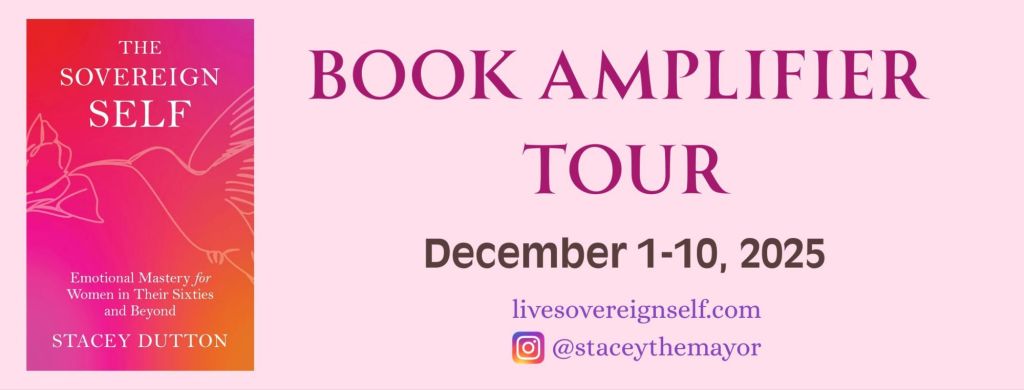
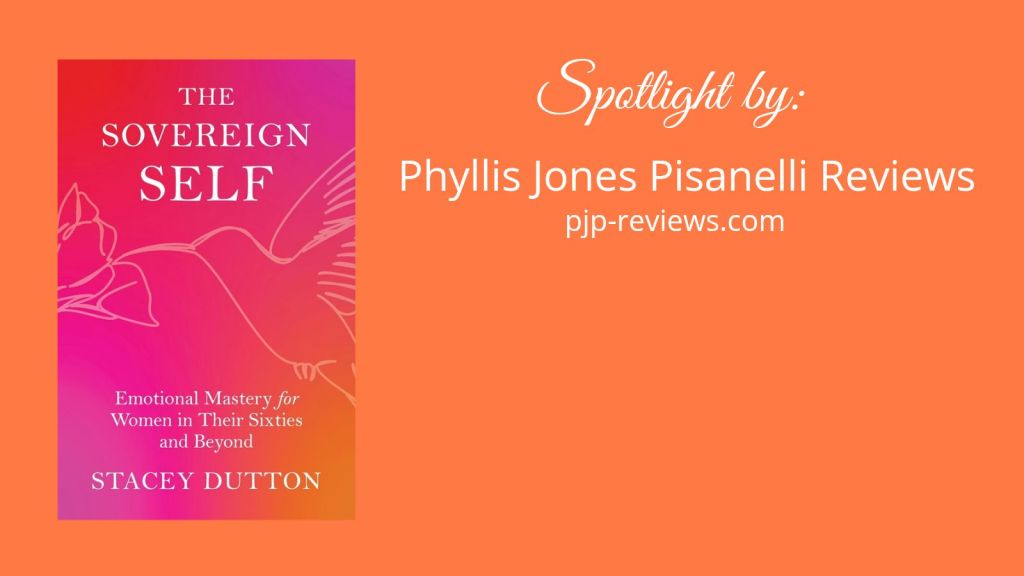
A Spotlight for you: SOVEREIGN SELF by Stacey Dutton

INTRODUCTION:

Themes of emotional clarity and the release of long-held roles come forward in The Sovereign Self by Stacey Dutton, a book that explores how the sixties reshape the inner landscape of women’s lives.

In The Sovereign Self, Stacey Dutton reflects on how entering the sixties signals a shift away from external expectations and toward deeper self-recognition. She examines how emotional mastery allows women to witness their patterns, choose intentional responses, and cultivate steadiness. The book explores identity evolution, the shedding of outdated obligations, the recalibration of relationships, and the invitation to live with less noise and more truth. Dutton also addresses spiritual curiosity, embodied living, postmenopausal changes, and the need for a more compassionate relationship with the body. Through thoughtful guidance, she positions this chapter as a time to reclaim one’s inner authority and live with grounded presence.

EXCERPT:

The Architecture of Emotional Mastery

“You have power over your mind—not outside events.
Realize this, and you will find strength.”
~ MARCUS AURELIUS

For a woman to be emotionally masterful in her sixties is not about mere resilience; it is about refinement. It is not about enduring hardship, but about engaging with life’s complexities with intention, intelligence, and grace.

EMOTIONAL MASTERY AS A DISCIPLINE
By our stage of life, we have encountered loss, reinvention, and profound shifts in identity. We have known both the exhilaration of new beginnings and the ache of things left behind. And yet, despite all we have lived through, true emotional mastery is not something we inherit simply because of experience. Rather, it is something we cultivate with discipline.
The difference between women who struggle through their later years and those who move through them with deep, unshakable presence is not related to their circumstances. It depends on their level of emotional mastery. Those who engage with their emotions deliberately, rather than being ruled by them, typically step into a state of emotional sovereignty—a place where external forces no longer dictate their internal stability.

MASTERY VS. SOVEREIGNTY
Mastery, in its truest sense, is about deep understanding more than control. To master our emotions does not mean suppressing them or forcing ourselves into an artificial state of positivity. It means learning to engage with our emotions as they arise, discerning which of them requires action and which requires release. It means standing in the midst of uncertainty, grief, or change and responding rather than reacting.

Sovereignty is the natural result of emotional mastery. When a woman reaches a place where her emotions no longer control her—a place where she can sit with discomfort without fear or experience joy without guilt—she becomes sovereign over her inner world. She is no longer subject either to the whims of others or to old wounds and the weight of societal expectations. She does not seek permission to feel, to express, or to change. She moves through life with an authority that cannot be given or taken away.

THE MIND AS AN EMOTIONAL ATHLETE
Much like physical strength, emotional mastery requires active engagement. A woman does not wake up one morning emotionally agile, just as she does not develop high muscle tone overnight. Emotional engagement is a practice, like going to Pilates class or lifting weights a few times a week. And yet, many women enter their sixties believing that emotional maturity should be automatic, a natural byproduct of their age.

If emotional mastery is the discipline, emotional sovereignty is the reward.

This is a fallacy. A woman who neglects her emotional strength and agility will find herself bound by old wounds, reactive tendencies, and outdated narratives.
But a woman who deliberately trains her mind—who practices stillness, discernment, and inquiry—will discover a different reality. She will no longer be pulled into every emotional undercurrent. She will not be at the mercy of her past. She will move through her days with a kind of cultivated stillness, unshaken by the temporary and attuned to what truly matters.

This is the foundation of everything that follows in her life.

ABOUT THE AUTHOR:

Stacey Dutton is an entertainment executive, creative producer, and emotional mastery advocate with more than three decades of experience across the music, television, and film industries. She was the original on-air host of TLC/Discovery’s Clean Sweep and later the casting director for the Emmy Award–winning Clean House on The Style Network. Through her developing platform, LiveSovereignSelf.com, she guides women in their third act toward clarity, boundaries, and emotional sovereignty. Stacey lives in New Preston, Connecticut, with her husband and their rescue dog. Visit Stacey at her website and on Instagram.

Amazon: https://amzn.to/48rD71T

Goodreads: https://www.goodreads.com/book/show/243569125-the-sovereign-self

GUEST POST:

From Hypervisibility to Invisibility: A Woman’s Lifelong Battle with Being Seen

Women are judged long before we ever understand what judgment is. Our bodies are evaluated, ranked, compared, whispered about, laughed at, or picked apart—often by the very people who claim to love us. And then, as if by some cruel joke, after decades of scrutiny and self-surveillance, we are suddenly told we’re invisible.

Before I was even a teenager, I learned exactly what society thought of me (or at least the people closest to me at that point in my life). I was made fun of for my “big, ugly” feet, my large forehead, my “big” thighs, and my “flat” chest. I absorbed every comment like it was a fact, not an opinion. In high school, a classmate once called me “Frankenstein” because I wore my hair pulled back in a ponytail. Her comment landed with such force that I immediately cut bangs to hide the “bad” forehead she had so generously pointed out.

By my thirties, I was thoroughly trained. When my marriage ended at 37, I celebrated my divorce the way many women do: by trying to “fix” the parts of myself I believed were wrong. My gift to myself was a boob job—because in my mind, getting rid of that “bad flat chest” was the perfect divorce present. Why grieve when you can cosmetically upgrade?

Then came my forties. Purely by accident, I landed an on-air hosting role for a new design show on TLC/Discovery Network. I should have been proud, but instead I received a piece of advice from my best friend at the time—a very famous actress who was no stranger to needles and scalpels: “Buy yourself a top lip,” she told me. Of course. I was about to be on television, so naturally I needed to do something unnatural to my face to look the part. I ended up with a “semi-permanent” lip injection from her facialist—a teeny-tiny bit in both the top and bottom lips, just enough to be “camera ready.” That’s what I told myself.

Then came my fifties—menopause, the grand finale of womanhood. The unexplained weight gain, the emotional upheaval, the shifting body that refuses to obey. That decade was a war with my reflection. I once told my sister before we went out that I needed to put on some makeup. Her response? “Who cares? No one’s looking at us anymore anyway.” It was also during my late fifties that I learned that two of my “friends” were exchanging screenshots of me online, dragging my bangs—because evidently some grown women still behave like “Mean Girl” middle schoolers with nothing better to do.

So that’s the arc: we go from being relentlessly judged—picked apart for every feature, every flaw, every deviation from the ideal—to being told we’re irrelevant. After spending decades trying to be pleasing, presentable, and perfect, we age out of visibility entirely.

Sarah Jessica Parker captured this perfectly when she responded to the barrage of criticism about her gray hair and her lines. She called it what it is: misogynist chatter. She pointed out that the scrutiny she faced would never be aimed at men. She asked what she was supposed to do about aging—stop aging or disappear? She spoke aloud what so many of us feel: that there is a strange, sinister enjoyment society takes in watching women “pained” by their own aging.

This is the impossible landscape women navigate: be beautiful, but not vain; sexy, but not trying too hard; youthful, but not fake; thin, but not obsessed; flawless, but “naturally.”

And when we inevitably fail at achieving the impossible—we vanish.

But here’s the truth: invisibility is not an indictment of our worth. It’s an indictment of the culture that taught us to measure it.

And maybe—just maybe—this stage of life is not about disappearing at all.

Maybe it’s about finally being seen by the only person whose gaze ever mattered: ourselves.

QUESTIONS & ANSWERS

Writing Process & Creativity

How did you research your book?
The research for my book came straight out of self-reflection and my own lived experience—the good, the bad, and the downright ugly. Every phase of my life, from childhood to this newest chapter, has taught me something worth examining. I also read philosophy every day, especially the Stoics, which at this point is like a form of therapy for me.

Where do you get your ideas?
This book was literally born from the journaling I’ve been doing over the past couple of years. I jot down notes after reading passages that hit me in the gut, and I’m constantly writing little reminders to myself about the things I still need to work on (lots of material right there!). So what began as my own personal manifesto—basically a handbook for keeping myself sane—eventually had me thinking, “Why not share it?”

What sets your book apart from others in your genre?
My book isn’t coming from a clinician, a guru, or someone pretending to have all the answers. It comes from someone who has lived through the transitions, reinventions, losses, joys, and identity shifts that women experience in their 50s, 60s, and beyond. Most books for women in midlife lean heavily into reinvention, “you go girl” energy, or vague self-help slogans. In mine, I’m offering a more refined approach: emotional intelligence, discernment, self-reflection, boundaries, and presence, speaking to women who are smart, self-aware, and tired of superficial advice.

Your Writing Life

Do you write every day? What’s your schedule?
I always write at home, usually with my dog on my lap which is challenging at times because his comfort takes priority way over mine. I journal first thing in the morning and then again in the evening; I write something every day, whether it’s pages and pages or just a couple sentences.

Behind the Book

Why did you choose this setting/topic?
I don’t think I chose this topic as much as the topic chose me. As I worked on my own personal growth and journaled about it, I saw this book begin to take shape.

Which author(s) most inspired you?
I’m most inspired by The Stoics. Stoic philosophy originated in ancient Greece and Rome and teaches one essential idea: you can’t control life, but you can absolutely control your response to it. At its core, Stoicism emphasizes emotional steadiness, self-mastery, perspective, and the ability to stay grounded even when life is chaotic. It’s about separating what you can influence from what you can’t and anchoring your peace in that distinction. Most modern therapeutic frameworks, especially Cognitive Behavioral Therapy (CBT) (which is the most widely used form of therapy today) are directly built on Stoic principles.

Fun & Lighthearted Qs

What’s your go-to comfort food?
Junk food: I LOVE potato chips. I’m all about savory foods. I also love sushi – my absolute fave.

What are you binge-watching right now?
The last series I binge watched was The Righteous Gemstones. BRILLIANTLY funny!

If you could time-travel, where would you go?
If I could time travel, I’d go straight ahead a century. I want to know if we’re living like the Jetsons, zipping around in flying cars or if the planet is even still thriving at all??

What 3 books would you bring to a desert island?
The Daily Stoic by Ryan Holiday, The Catcher in The Rye by J.D. Salinger, and The Midnight Library by Matt Haig. Some philosophy, some laughs, and some entertaining fantasy.

What’s something that made you laugh this week?
About five minutes ago my 20-pound, VERY reserved and well-behaved dog let out an enormously loud fart. I had no idea dogs could fart so loudly.

SPOTLIGHT: The Book of Four Journeys by Veronica del Valle

INTRODUCTION:

There’s a particular pull in stories that follow characters stepping away from what they know and into landscapes that challenge their sense of direction. The Book of Four Journeys by Veronica del Valle brings together four such moments, each defined by movement and change. These stories explore what unfolds when the familiar falls away and a new path quietly begins to take shape.

The Book of Four Journeys gathers four short stories connected by a central question: how does a journey shape the one who takes it? Through the perspectives of Alfalfa Spooly, Mumik and Pimnik, Neboo McCloudy, and Lincoln Jax, the book explores what unfolds when curiosity and necessity push characters away from what they know and toward what they must discover.

Alfalfa Spooly is a postman drawn into a mission that demands he cross into the unknown, challenging his sense of order and routine. Siblings Mumik and Pimnik embark on separate adventures in search of each other, each navigating unfamiliar paths filled with unexpected obstacles. Neboo McCloudy, a creature defined by his grumpiness and hesitation, faces his fears as he seeks a mysterious treasure tied to a world beyond his own. Meanwhile, Lincoln Jax, an orphan fueled by determination, follows a route that may lead her to a kingdom holding long-awaited answers.

With its blend of unpredictable turns and unusual characters, this collection highlights the courage found in taking the next step—no matter how uncertain.

EXCERPT: THE BOOK OF FOUR JOURNEYS (From the story Mumik & Pimnik)

Day One
In the Northernmost Part of the World

Mumik Opipok opened his eyes and knew straight away what he had to do. It would take courage, loads of it. He would have to summon it all because he was not the most confident person. In fact, Mumik Opipok’s life had so far been dotted with doubtful moments: should I fish with my fishing rod or with my net? Should I walk to the lake or go on my sledge? Should I wear my white scarf or my checquered one? Should I make fish fillet, or seafood chowder for lunch? For each choice, Mumik debated with himself for hours, and when he finally made a choice, he would second-guess it one more time. Just in case.

But not that morning. Mumik was more confident than he had ever been about any decision. In fact, he had made up his mind as soon as he’d heard what the White Bright Sprite had told him. He knew what he had to do. There was no other way to look at it.

From that moment, his day was dedicated to getting everything ready for his journey. He borrowed an old sailboat courtesy of a former sailor-turned-igloo-maker who had a spare boat. It was rusty, but it floated and that was what mattered. The former sailor-turned-igloo-maker taught Mumik the essentials of sailing: the menaces one can find at sea, how to read charts, how to trim the mainsail and how to use a sextant to let the stars guide him to his destination.

When the sailing class was over, Mumik walked home. He lived in an igloo of bluish blocks of ice in the Northernmost Part of the World. “The top of the globe,” he liked to say. This was a place shrouded in eternal winter, which meant it was always very very cold, but also very very snowy, silvery white and spotless. His good friend, Koko, a wordy and cunning Arctic fox, was waiting by his front door.

“All ready?” Koko asked.
“Almost,” Mumik answered. “Where are Sesi and Sila?”
“Around the back of the igloo, sleeping like true grey wolves,” Koko said.

Mumik went inside and packed some items of clothing, his fishing rod, some cans of food and many bottles of water. He was aware he was not the best planner, but he figured he would be fine with the things he had selected. Before sunset, everything was ready. He would leave in the morning.
When the full moon lit the sky, Mumik went outside and woke up Sesi and Sila.

“Come on, my friends, time for one last ride.”

ABOUT THE AUTHOR:

Veronica del Valle is the author of The Word-Keeper and The Book of Four Journeys. She holds an MA in Creative Writing from Kingston University and has worked as an editor and writer for news organizations and magazines in both London and Argentina. She has also taught creative writing at Universidad de San Andrés. Now based in Buenos Aires, she continues to write stories shaped by her love of language, imagination, and adventure. Learn more at her website and on Instagram.

Amazon: https://bit.ly/47XykFd
Goodreads: https://www.goodreads.com/book/show/58025684-the-book-of-four-journeys

What My Daughter Taught Me About Writing

Children, I’ve learned, are the sharpest editors: curious, unsparing, and attuned to truth in ways adults often forget. One such child is my nine-year-old daughter, Tomiko. Wild-hearted and keenly observant, she’s taught me as much—perhaps more—about writing for children than any book or editor ever could.
If I had to distill the things I’ve learnt from her, it would take the shape of six essential reminders:
1. Children have an extraordinary radar for plot holes. If something doesn’t make sense, they’ll find it instantly, and let you know. They spot every inconsistency, every lazy sentence, every moment when the writer is no longer fully awake.
2. Logic matters as much as magic. If an imp appears, it must have a reason to be there. If a door opens into another world, it must do so with purpose.
3. Stories must earn attention. Adults might politely finish a chapter. Children will simply walk away.
4. Rhythm is key. Not just in language, but in the movement of the tale. A story must breathe, shift, and hold wonder.
5. Children don’t read to admire your prose; they read to believe.
6. Stories must find their way not only through the narrative, but into the reader. They must stir something real. The wilder the tale, the truer the emotion must be.
Over time, I’ve come to understand two things:
One: children don’t ask for perfection. They ask to be met with awe, coherence, and heart. And two: the best children’s stories are written for children, but they’re also written from the part of us that still remembers what it felt like to be one.

Writing Process & Creativity

How did you research your book?
The Book of Four Journeys grew out of my fascination with the idea of the hero’s journey —that timeless mythic pattern that reveals how every adventure is, in the end, a path toward self-discovery. I wanted to explore what that means for younger readers today, in a world that often feels both vast and uncertain.

Where do you get your ideas?
Honestly, I don’t really know. Everywhere around me. Everywhere within me, too. I’m not sure.
Sometimes ideas come from things I’ve read, people I’ve met, or places I’ve travelled to. Other times, they seem to rise from somewhere deep inside, very much uninvited.
I often wonder where ideas truly come from; they feel less like something we invent and more like something we stumble upon.

What sets your book apart from others in your genre?
The reader will not find any dragons, wizards or witches in this book, but that doesn’t mean it is not filled with the most peculiar and unexpected characters, like Alfalfa Spooly, a postman who will dare cross the threshold into the unknown to carry out a menacing mission. Mumik and Pimnik, a brother and a sister who will explore unknown territories as they set about finding each other. Neboo McCloudy, a grumpy creature ready to weather his biggest fears so he can discover an otherworldly treasure. And Lincoln Jax, an orphan girl in search of a kingdom that holds the answer to everything she is looking for.

What helps you overcome writer’s block?
I go for a walk; movement somehow frees the story. There’s something about being outside, and in motion, that untangles whatever was stuck on the page.

What’s your favorite compliment you’ve received as a writer?
My favorite compliment comes when a child says they loved the story, or that it helped or inspired them. There’s a raw, unfiltered honesty in a kid’s reaction. There’s no polish, no pretense, just the truth. It’s the ultimate review.

Your Writing Life

Do you write every day? What’s your schedule?
Where do you write—home, coffee shop, train?
Any quirky writing rituals or must-have snacks?

I try to write every day. Discipline is very important to me, even if some days I only manage one very bad sentence. If I waited for inspiration to come, I suspect I’d still be curating an exquisite collection of half-written stories.
It might sound painfully boring, but I always write in the mornings at my desk in complete silence, with (this bit is less boring; and it’s essential and delicious) mate —a traditional Argentine tea— always by my side.
Although I’m no illustrator, I like to sketch characters, places, and maps on paper. Then I pin them to a moodboard above my desk, so the world of the book I’m writing stares back at me while I work.

Behind the Book

Why did you choose this setting/topic?
As I said above, this book grew out of my fascination with the concept of the hero’s journey; the idea that every great adventure, no matter how far it takes you, is ultimately about finding out who you are.

From Gulliver’s Travels to The Odyssey and The Adventures of Huckleberry Finn, I’ve always been fascinated by how these stories chart the outer world as a reflection of the inner one; how every voyage, no matter how distant, mirrors a deeper transformation within.

If your book became a movie, who would star in it?
If my book became a movie, I’d love it to be a Studio Ghibli film. Their worlds feel lived-in, and their magic is quiet and true and woven from wonder.

Which author(s) most inspired you?
I’d say there are three —no, four— authors who’ve inspired me the most:

E. B. White, for his love of the English language, and because he taught me that children are among the most attentive and intelligent readers, making them an audience that deserves the writer’s best work. He said, “Anyone who writes down to children is simply wasting his time. You have to write up, not down.” Those words have always stayed with me.
Philip Pullman, because there’s a kind of yearning in his writing that tugs at your heart —a deep hunger for life, for love, for knowledge and for adventure.
Roald Dahl, because he’s unapologetically himself —bold, mischievous, idiosyncratic, and delightfully unafraid.
And Dr. Seuss, for his wild, limitless creativity and the rhythm and joy that make his words leap off the page. He reminds me that nonsense can make perfect sense and that imagination can be a form of courage.

Fun & Lighthearted Qs

What’s your go-to comfort food?
Anything homemade: a warm oatmeal cookie, a delicious spinach pie, freshly baked bread. If it’s homemade with love (and good music playing in the kitchen while you cook), it’s comfort food in the truest sense.

What are you binge-watching right now?
My daughter and I are watching the three Paddington movies on a loop. I love them —I love the Michael Bond books too, of course— but the films are equally delightful.

If you could time-travel, where would you go?
I wouldn’t travel in time, but I would love to visit a parallel universe. Maybe one where imagination is the main currency and dreams are taken incredibly seriously.

What 3 books would you bring to a desert island?
I’d bring Philip Pullman’s His Dark Materials trilogy… And Dr. Seuss’s Oh, the Places You’ll Go! (because even on a desert island, it reminds you that life is an adventure.)

What’s something that made you laugh this week?
My daughter, Tomiko. She’s nine and has the wittiest, most outlandish sense of humor —it’s like Monty Python but in a nine-year-old version.

Bringing You a Spotlight of The Amalfi Secret by Dean Reineking & Catherine Reineking

Genre: International Mystery and Crime
Release Date: October 7, 2025

INTRODUCTION:

For readers drawn to stories where heart and history intertwine, The Amalfi Secret by Dean and Catherine Reineking delivers a sweeping blend of mystery, emotion, and international intrigue.

When Gabe Roslo arrives on Italy’s Amalfi Coast for a long-overdue reunion with his grandparents, the trip takes a devastating turn. His beloved grandfather’s sudden death leaves behind a diary filled with cryptic entries—clues to a hidden legacy that reaches far beyond the family’s past. Joined by Anna, a fearless and intuitive Roman local, Gabe sets out on a quest for truth that leads him through ancient cathedrals, political shadows, and secret archives. Each discovery brings them closer to unraveling a conspiracy that could alter the balance of power—and threatens to destroy them both.

ABOUT THE AUTHORS:

Dean and Catherine Reineking are a husband-and-wife writing duo who channel their shared love of history, travel, and storytelling into evocative, thought-provoking thrillers. Dean’s decades in finance and global consulting lend structure and authenticity to their plots, while Catherine’s background in teaching and counseling infuses their characters with emotional realism and empathy. Their work reflects a fascination with human courage and the hidden intersections of truth and power. Learn more on their website.

Amazon: https://amzn.to/46QlGGb
Goodreads: https://www.goodreads.com/book/show/238969332-the-amalfi-secret

Tell Me Why by Kay Bratt ~ 5⭐️

Genre: Women’s Crime Fiction
Release Date: November 24, 2025

REVIEW:

Tell Me Why by Kay Bratt is the latest new book in the Hart’s Ridge series. It is book number 14! That alone should tell you how popular this series is. The readers of this series keep begging for more. As far as I am concerned, it could go on forever and I will still be reading it. Let me tell you why this clicks all the boxes for me.

I think the number one reason is that I have been able to feel like part of the Gray family. Taylor Gray started in this series as a sheriff with the local department and was trying to work her way up to detective and never made it. She and her husband now have their own detective agency. I have grown to love her and the rest of her family. They are an interesting bunch and have been through a lot.

The second reason is I love police and detective/mystery books. This series hits most of my favorite genres. There are Romance, Crime, Family of course Mystery and Detective stories in this series. I generally think there is something for everyone in this series. 

The third reason is the family runs an animal shelter. They are raising money and taking care of animals that need someone to look after them. They find homes for them when they are healthy. They have provided jobs and living space for the ones they grow close to and most of the family lives in the compound. Idyllic.

Another theme you know I love is the town of Hart’s Ridge is a small mountain town. I love small towns. There is always a variety of characters in the small towns to keep them interesting. I just think small towns are more caring for their town folk.

Kay Bratt’s Tell Me Why is again one of the best books in the series. They just keep getting better and better. There are twists and turns that will keep you turning pages long past your bedtime. I highly recommend the Hart’s Ridge series for your reading pleasure. Until Next time…Happy Reading!

Don’t forget to support the authors you read by leaving a review. Even a few words help.

I received a complimentary copy of this book from the author. The opinions I have expressed are my own and I was not required to write a review. I am disclosing this in accordance with the Federal Trade Commission’s 16 CFR, Part 255.

SYNOPSIS:

In Hart’s Ridge, secrets don’t stay buried. They burn.

When a charred vehicle is found abandoned on the outskirts of town—with a body too damaged to identify inside—private investigator Taylor Gray is called to the scene. But nothing prepares her for the possibility that the victim might be someone she once called family.

As rumors swirl and grief ripples through Hart’s Ridge, Taylor digs deep into the investigation, uncovering ties to a shady local business, a trail of hidden cash, and a growing list of people with something to hide. Every lead pulls her further into a dark web of corruption, addiction, and betrayal—and closer to a truth that someone is desperate to keep buried.

With her instincts sharp and her heart on the line, Taylor must race to connect the dots before another life is lost. Because in this town, justice isn’t just personal—it’s dangerous.

From Kay Bratt, bestselling author of the Hart’s Ridge series, comes a gripping small-town mystery full of unforgettable characters, shocking twists, and emotional depth. Tell Me Why is perfect for fans of crime fiction, women sleuths, Southern suspense, and stories where family ties cut both ways.

ABOUT THE AUTHOR:

Writer, Rescuer, Wanderer

Kay Bratt is the powerhouse author behind over 30 internationally bestselling books that span genres from mystery and women’s fiction to memoir and historical fiction. Her books are renowned for delivering an emotional wallop wrapped in gripping storylines. Her Hart’s Ridge small-town mystery series earned her the coveted title of Amazon All Star Author and continues to be one of her most successful projects out of her more than two million books sold around the world.

Kay’s literary works have sparked lively book club discussions wide-reaching, with her works translated into multiple languages, including German, Korean, Chinese, Hungarian, Czech, and Estonian.

Beyond her writing, Kay passionately dedicates herself to rescue missions, championing animal welfare as the former Director of Advocacy for Yorkie Rescue of the Carolinas. She considers herself a lifelong advocate for children, having volunteered extensively in a Chinese orphanage and supported nonprofit organizations like An Orphan’s Wish (AOW), Pearl River Outreach, and Love Without Boundaries. In the USA, Kay served as a Court Appointed Special Advocate (CASA) for abused and neglected children in Georgia, as well as spearheaded numerous outreach programs for underprivileged kids in South Carolina.

As a wanderlust-driven soul, Kay has called nearly three dozen different homes on two continents her own. Her globetrotting adventures have taken her to captivating destinations across Mexico, Thailand, Malaysia, China, the Philippines, Central America, the Bahamas, and Australia. Today, she and her soulmate of 31 years live in Saint Augustine, Florida.

Described as southern, spicy, and a touch sassy, Kay loves to share her life’s antics with the Bratt Pack on social media. Follow her on Facebook, Twitter, and Instagram to join the fun and buckle up for the ride of a lifetime. Explore her popular catalog of published works at Kay Bratt Dot-Com and never miss a new release (or her latest Bratt Pack drama) by signing up for her monthly email newsletter.

The Wicked Witch of the West: The Enduring Legacy of a Feminist Icon by Lona Bailey

Genre: Popular Culture in Social Sciences
Release Date: October 2, 2025

INTRODUCTION:

For generations, the Wicked Witch of the West has stood as one of fiction’s most iconic figures—a shadowy presence both feared and fascinating. In The Wicked Witch of the West: The Enduring Legacy of a Feminist Icon, Dr. Lona Bailey reclaims this figure from the realm of villainy and reintroduces her as a defiant emblem of womanhood, misunderstood by the very culture that created her.

Bailey’s exploration moves beyond Oz’s yellow bricks and into the social fabric that has defined—and confined—powerful women for more than a century. From L. Frank Baum’s original vision to modern reinterpretations like Wicked, Bailey illuminates how the Witch’s story has mirrored women’s evolving battles for respect, equality, and voice. Each adaptation, she argues, reveals something about the world’s comfort—or discomfort—with women who dare to wield influence. Richly researched and beautifully written, the book examines how this so-called “wickedness” is in truth a reclamation of autonomy, making the Witch a living metaphor for every woman who has ever refused to shrink herself.

EXCERPT:

It’s quite impossible to explore the icon of the Wicked Witch without acknowledging Margaret Hamilton’s unforgettable portrayal of the character, as she is widely credited with introducing her to the world in a way that has captivated audiences ever since. Was it the green skin, broom, cackling laughter, exaggerated hook to her nose, or sharp-tongued quips that embedded her into cultural consciousness? Perhaps all of those things and more initially made the world fall fast and hard for the fiendish character, but only in the context of Margaret Hamilton’s simply splendid portrayal.

“I was walking down Fifth Avenue in New York not long ago when a nice-looking young man called to me. ‘Miss Hamilton,’ he said, ‘you don’t know me, but I know you. You scared the pants off me when I was a little boy,’” Margaret Hamilton recalled.1 The barely five-foot-tall Margaret “Maggie” Hamilton has managed to terrify millions for more than eighty-five years in her characterization of L. Frank Baum’s Wicked Witch of the West. What began as a fairly one-dimensional antagonist with few descriptives beyond her general reputation for wickedness, was suddenly and frighteningly brought to life thirty-nine years after she was penned in Baum’s book and the legend of The Wizard of Oz truly began. In following suit with what “that little animation company” Walt Disney did in the successful film adaptation of the children’s fantasy story Snow White and the Seven Dwarfs, MGM bought the rights to adapt Baum’s novel The Wonderful Wizard of Oz to brilliant Technicolor in 1938. The demigod of MGM, Louis B. Mayer, purchased the book’s rights in the fall of 1937 upon the suggestion of Mervyn LeRoy. Mayer saw grand potential in a musical version of the children’s novel and with LeRoy and Arthur Freed on board, revisions toward final production were initially promising. The script went through a merry-go-round of revisions from its initial draft to its on-screen presentation with cuts, edits, rewrites, and additions from legions of hired, fired, and rehired writers. 

The only mainstays were the leading cast—well, sort of. Judy Garland was cast as Dorothy, Frank Morgan as the Wizard (and several other supporting roles), Ray Bolger as the Scarecrow/Hunk, Bert Lahr as the Lion/Zeke, Jack Haley as the Tin Man/Hickory, Billie Burke as Glinda, and Hamilton as the Wicked Witch of the West/Miss Gulch. 

Originally, actress Gale Sondergaard was cast as the Wicked Witch, but being a bit too glamorous for such a haggy and undesirable part, Sondergaard withdrew from the production and Hamilton was offered the role just three days before filming began. Hamilton had appeared in several films for MGM by 1938, and with her distinct features and knack for spinster supports, Director Victor Fleming thought she was a natural choice for the queen of mean. 

Whether or not Hamilton knew of Matilda Joslyn Gage as “the woman behind the curtain” of Baum’s novel, in her portrayal, she creatively matched the feministic intentions of the original story’s creator. While the Technicolor Wizard of Oz fostered the stereotypical image of what “witches” were believed to look like in the 1930s. 

Witches were generally considered sallow, sexless figures whose rebellious and/or peculiar behavior had caused them to be ostracized by the general public. One early exception to this is Edmund Spenser’s The Faerie Queene (1590) with the character of Acrasia, the enchantress who uses her beauty to seduce and corrupt knights. Unlike the longstanding, older, and malevolent image of witches, Acrasia is described as physically alluring and beguiling, using her appearance and charm as weapons to achieve her goals. Though still a nonconformist in Spenser’s story, Acrasia’s beauty masks her dangerous nature, a theme that has been echoed in later depictions of witches in literature and folklore, though most classic literature purports “witch” to be synonymous with “ugly.” 

Nonconformist characteristics (described in horrid terms) usually included degrees of unsightly yellow or red complexions, unkempt, stringy hair, exaggerated facial features, and of course, warts. For example, William Shakespeare’s witches, the “Weird Sisters” in Macbeth, are described as dirty, haggish rebels who live separately from society and possess not only mystical powers but also distinctively masculine features such as beards. Any beauty that was ascribed to a witch before the postmodern reinvention of her image was usually only a magical cover for her “true” haggish nature, which she ruthlessly used to further her evil agenda. For better or for worse, MGM began the reinvention process of the witch, and Margaret Hamilton’s face was the canvas on which they painted—literally. With a hooked nose, green skin, pointy chin, crystal ball to spy on her enemies, and dressed all in black with a flying broom, Hamilton herself subtly fostered a more progressive approach to villainy in that inch of redemption she gifted the character through her own touch of feministic essence despite her convincing malevolence on screen. 

Contrary to most villainesses in early literature, film, and television, the Wicked Witch was not a masculine character. Perhaps we wouldn’t call her “pretty” in the green paint and prosthetics, but still Hamilton brought a subtle, yet undeniable femininity to the role that changed the “look” of a “witch” in the general sense. The paradox of Hamilton’s portrayal in such a traditional era was that she brought both femininity and feminism to the characterization. Billie Burke, on the other hand, certainly brought femininity to “Good Witch Glinda,” and her delicate, docile characterization stuck closely by Baum’s original non-feministic “Good Witch.” Burke seemed to naturally exude a dainty energy and sense of glamour as Glinda, which is also what the role required, but as far as MGM was concerned, Margaret Hamilton’s subtle artistic strokes of feminism weren’t of importance just so long as she, as the “bad one” was scary and not too “pretty.”

From Lona Bailey:

While researching this book, I discovered just how much world history has culminated to give us what we now recognize as the icon of the Wicked Witch. Her evolution was absolutely fascinating to trace. We tend to think of witches in fiction as timeless villainesses who have “always” existed in a fixed way, but that couldn’t be further from the truth. The figure of the witch reaches back to ancient civilizations—where she could be feared, revered, or misunderstood—and over the centuries she has been shaped by religion, politics, gender norms, and folklore. What struck me most was how, in the last hundred years especially, the witch has transformed from a symbol of evil into one of independence and feminine strength.

That journey mirrors so much of women’s history itself: the push from suppression to empowerment, from being silenced to reclaiming voice and agency. Even on the set of The Wizard of Oz, you can see this cultural tension at play in the contrast between Margaret Hamilton’s “wicked” witch and Billie Burke’s “good” one—both the characters and the actresses were shaped by typecasting, the misogynistic “old studio system,” unrealistic beauty standards of the Golden Era of Hollywood, and class perceptions of their time. This was heartbreaking, yet important for me to better understand, because we—so many decades removed from their era—tend to see everyone in films like The Wizard of Oz as glamorous stars, but in real time, there were studio system biases that caused great woundedness for many like Hamilton who dared to be different. The harmful stereotyping in bygone eras not only shaped the icon of the Wicked Witch, but actresses like Hamilton who portrayed her.  

 Digging into these layers made me realize that the Wicked Witch isn’t just a fictional figure, she’s a cultural mirror. Every generation redefines her based on what it fears—or celebrates—about powerful women. That discovery gave the project a deeper meaning and made me fall even more in love with her story.

Questions & Answers:

Writing Process & Creativity

How did you research your book?

I dove deep into everything from MGM archives to feminist theory journals, historical folklore books, and even old fan magazines. I wanted to understand not just the Wicked Witch herself but how audiences across decades have reacted to her and why. It was part film history, part cultural detective work and I loved every minute of it! 

What’s the hardest scene or character you wrote & why?

Honestly, there really weren’t many, if any, “hard” parts to write for this book—it was fun and engaging from start to finish. Every chapter felt like uncovering a new layer of the Witch’s legacy, and the deeper I went, the more fascinating she became. It was one of those rare projects that energized me instead of exhausting me.

Where do you get your ideas?

Usually from questions or topics of intrigue that just won’t leave me alone. With this book, it started with, “Why do we still fear the Witch, but secretly root for her too?” That curiosity turned into a full-blown exploration of power, femininity, and legacy and what perfect timing with the film adaptations of Wicked! 

What sets your book apart from others in your genre?

I think this is one of the first books about the Wicked Witch herself not just in the context of film history, but in a broader cultural conversation. I have tried to blend Hollywood storytelling with feminist analysis, so readers get equal parts behind-the-scenes entertainment lore and what-does-this-say-about-me insight.

What helps you overcome writer’s block?

When writer’s block hits, I get up and move—I take a walk or slip into a good young adult fiction I enjoyed when I was younger (I’m a huge Nancy Drew fan!). Something about the rhythm of walking or the familiar creative tangles of a Nancy Drew or Goosebumps story helps the next line find me instead of the other way around.

What’s your favorite compliment you’ve received as a writer?

Several people over the years have told me after reading a biography I wrote of their loved one— someone I never had the chance to meet in life – that it felt as though I had known them personally. That’s one of the greatest compliments I could ever receive as a researcher and writer. It tells me my research was thorough, my interpretation true to the person, and that I succeeded in bringing their spirit to life on the page. 

Your Writing Life

Do you write every day? What’s your schedule?

Like many writers, I usually write something every day, even if it’s just a few paragraphs or some notes. I’m most creative in the mornings, so I like to get my coffee, open my laptop, and dive right in when I can. Some days it’s research, other days it’s full-on storytelling, but luckily I enjoy both.

Where do you write—home, coffee shop, train?

Mostly in my home office—it’s my creative haven. I’ve built a cozy writing space that feels both peaceful and inspiring, filled with books and old Hollywood memorabilia that keep me grounded in the era I often write about.

Any quirky writing rituals or must-have snacks? 

I always have my furry sidekick, Penny the morkiepoo, curled up on my desk as my “lucky Penny.” She’s my little muse. I also choose a new candle for each book I write—a scent and name that somehow connect to the story at hand—and I burn it every time I work on that project. It’s my way of setting the mood and signaling to my brain, it’s time to write.

Behind the Book

Why did you choose this setting/topic?

I’ve always been fascinated by Margaret Hamilton’s portrayal of the Wicked Witch, and it occurred to me a couple of years ago that she did not have a full-length biography. After some preliminary research, I realized the potential for combining a bit of Hamilton’s story into the larger story of the Wicked Witch. The Wicked Witch of the West is so much more than a villainess—she’s a mirror of how women’s power and independence have been viewed through time, which are always topics of importance. Writing this book gave me the chance to explore her evolution from fearsome figure to feminist icon and the timing of the Wicked films was “spookily” perfect. 

If your book became a movie, who would star in it?

Though nonfiction academically postured books are sometimes harder to adapt to film, if it were to happen I would love to see someone like Sigourney Weaver or Anjelica Huston bring the Witch’s complexity to life—they both have that rare ability to blend elegance, strength, and mystery. Of course, a musical cameo by Kristin Chenoweth or Cynthia Erivo would be the perfect nod to the Witch’s modern legacy!

Which author(s) most inspired you?

I’ve always loved classic literature—there’s something timeless about the way those writers captured human complexity. Faulkner and Tennessee Williams are two of my favorites for their depth and southern sensibility, but I also adore Kate Chopin and Shirley Jackson for the way they explored women’s inner lives with such courage and nuance. Their influence definitely weaves its way into how I approach character and theme in my own writing.

Fun & Lighthearted Qs

What’s your go-to comfort food?

Coffee. Does a drink count? 

What are you binge-watching right now?

Judge Judy. It’s been my go-to comfort show for decades! 

If you could time-travel, where would you go?

I’d go straight to 1940s Hollywood to see the Golden Age in full swing with the studio sets, radio broadcasts, and all that behind-the-scenes glamour I’m always writing about. I would also sit outside Clark Gable’s dressing room for as long as it took to meet him!

What 3 books would you bring to a desert island?

The Bible, The Great Gatsby, and A Light in August. 

What’s something that made you laugh this week?

I’m a big vaudeville fan, so I always laugh when I catch glimpses of that kind of comedy in everyday life. The other day, I looked out my home office window and saw a rather small pickup truck slowly rolling down the road with a huge pile of mismatched chairs rounded over to the sky in the back. Miraculously, nothing fell off, but the whole scene looked like something out of a Three Stooges episode, and I couldn’t help but laugh while I took a picture of it. 

ABOUT THE AUTHOR:

Dr. Lona Bailey is a decorated biographer and historian whose work honors women who helped shape Hollywood’s Golden Age but were often left in the footnotes of history. Her acclaimed books—Uncredited, Voice of Villainy, Mrs. Radio, and The Wasp Woman—give voice to the silenced and offer an empathetic lens on fame, artistry, and identity. With a PhD and experience as a therapist, Bailey brings psychological depth to her storytelling, revealing not just the facts but the humanity behind each life. Her Voice of Villainy biography was an award-winner in 2023, earning both international and national honors. Discover more of her work on her website or connect on Facebook.

Amazon: https://amzn.to/4nHUMH4

Goodreads: https://www.goodreads.com/book/show/233812615-wicked-witch-of-the-west

Second Dance by Tess Thompson ~ 5⭐️

Genre: Later in Life Romance Release
Date: November 20, 2025

REVIEW:

Second Dance by Tess Thompson was almost a fairy tale. I loved every minute I spent with this book. If you remember, I read Second Act, which is a prequel to The Parent App Series. I was so excited when I finished that book, I immediately knew I wanted to read the remainder of the series.

When the Second Dance hit my inbox, I couldn’t wait to crack it open and get reading. The series is about 5 women who all had children starting their first day of school. They met at a coffee gathering for moms who were leaving their kids at school for the first time. They became like family over the years. The kids are now in high school and decide their moms need a man in their lives when they leave for college so they put their moms profile on a dating app. Each book is a different mom’s experience at finding forever love. 

The Second Dance is about Gillian Horton who is reunited with her first true love Alex Garcia. These two characters were so warm and loving they made my heart sing. Alex is a widow and Gillian has never been married. Gillian is so understanding of young people and is patient and kind. Just the kind of parents you want to see today.

I’ve found myself leaning more toward romance lately. I think the main reason is it is a kinder and gentler world than the one we are living in right now. I think I need that escape from all the violent and horrible crimes that are happening right now. I find myself crying during the news at night and these books bring such joy into my life.

If you are like me and looking for books that are uplifting and make you forget the horror that is going on around you, then I highly recommend The Parent App Series. I suspect these books will be somewhat standalones but, we are early in the series so read the prequel first and then jump right in. I think the next book is coming out fairly soon and you will be ready for it. They definitely belong on your nightstand to bring you sweet dreams. Until next time…Happy Reading!

Don’t forget to support the authors you read by leaving a review. Even a few words help.

I received a complimentary copy of this book from the author. The opinions I have expressed are my own and I was not required to write a review. I am disclosing this in accordance with the Federal Trade Commission’s 16 CFR, Part 255.

SYNOPSIS:

She never forgot her first love. Her daughter just found him on a dating app.

One summer in New York City, Gillian Horton met Alex Garcia—the boy who made her laugh, dream, and fall head over heels. Then tragedy struck. Gillian returned home to raise her infant niece, and Alex went back to MIT. Their love story ended in silence.

Fourteen years later, Gillian has built a life in Willet Cove. Grace, the little girl she raised, is now a teenager who longs for a father. What Gillian doesn’t know is that Grace and her friends have secretly put her profile on a dating app. And the first match to appear nearly stops Grace’s heart—Alex Garcia, widowed billionaire and single father of two.
Seeing Alex again shakes Gillian to her core. His teenagers raise painful questions about whether he had a family the summer he loved her. But as Grace soon discovers, the truth is more complicated—and maybe more hopeful—than her mother believes.

Reuniting first love is never simple. With trust to rebuild, families to blend, and grief still tender, Gillian and Alex must find the courage to risk their hearts again. Because some dances are worth a second chance.

ABOUT THE AUTHOR:

Tess Thompson is the USA Today Bestselling and award-winning author of contemporary and historical Romantic Women’s Fiction with over 50 published titles. Her books are emotional and heartwarming with themes of second chances, redemption and the power love has to change lives and create community.

She lives in the Pacific Northwest in a house on a small lake with her husband and kitties. Her four children are now young adults exploring their own paths and adventures, leaving an empty nest and a lot more time to write. She and her husband enjoy a quiet life, obsessed with birds and the other wildlife on their property, which makes them officially old. On any given day their yard could be visited by deer, bears, coyotes and squirrels.

Most days, she can be found curled up in her favorite chair reading or in her office writing while keeping an eye out for hummingbirds in the feeder outside of her office.

The French Effect by Patricia Sands ~ 5⭐️

Genre: Late in Life Holiday Romance
Release Date: November 15, 2025

REVIEW:

Patricia Sands has once again captured my heart and taken me into a brand new world of new friends and experiences with her brand new book The French Effect. I will never have an experience like this in my lifetime on earth. With this book we entered the world of Paris and met some wonderful people. I can’t wait for you to meet them!

We first meet Nora Bennet who is from Ontario. Her daughter, Chloe was married and moved to Paris three years ago. Nora is a widow and has not celebrated the holidays in a few years. Chloe calls when Nora is experiencing restlessness and writer’s block. She invites her mom to Paris to pet sit for her neighbor’s dog. The dog is Atticus and is a doberman. That scares Nora a bit. Nora is not one to act impulsively but, she decides to take the opportunity to be with her daughter and we’re off on a whirlwind of experiences!

When Nora gets to Paris we meet Olivier who is Chloe’s husband and his father Pierre. We also get the story of 93 year old Marie-Louise who lived through the Occupation as a child. Nora has agreed to ghostwrite her memoir. If you have ever read anything during this time period you know it is a very moving time in history. There are many more interesting people in this book.

I learned some of the customs in France and the people there are much different than they are here. It sounds like it is a much safer environment and a healthier lifestyle. My imagination was running wild! I’m not sure I would really enjoy the tourist areas but, the neighborhoods and the way of life was something to really think about. They love their dogs in France and they are welcome in eateries and are brought water to drink while they are waiting for their people to eat. How fun is that?

This book does take place just before, during, and after the holiday season. To be able to experience that in this book was priceless. If you are looking for a unique holiday book to warm your heart, I highly recommend The French Effect by Patricia Sands for your bedside table. I will be living in the world of this book for a few days and it may stay with me much longer. It is that good! Until next time…Happy Reading!

Don’t forget to support the authors you read by leaving a review. Even a few words help.

I received a complimentary copy of this book from the author. The opinions I have expressed are my own and I was not required to write a review. I am disclosing this in accordance with the Federal Trade Commission’s 16 CFR, Part 255.

SYNOPSIS:

From the bestselling author of the LOVE IN PROVENCE series, comes a hopeful and heartwarming journey that reminds us it’s never too late for a second chance.

France has a way of changing your mind … and your heart …

Novelist Nora Bennett is living her fifties with more doubts than dreams. Once content with her quiet life, she’s recently found herself battling writer’s block, a growing restlessness—and resistance to a holiday season she’s long stopped celebrating. So, when her daughter Chloe, an artist living in Paris, asks her to dog-sit an intimidating Doberman named Atticus, Nora surprises
them both by saying yes.

Delicious meals, long walks through the storied streets of Montmartre, and a chance to rediscover a spark of joy in the glittering holiday lights of Paris: Six weeks in the City of Light might be just the escape Nora needs.

Except Paris has other plans. Nora agrees to ghostwrite a memoir for 93-year-old Marie-Louise, who reveals haunting memories of surviving the Occupation as a child of the Resistance. A charming younger tango partner with secrets of his own introduces Nora to the French art of pleasure. All the while, the city’s irresistible festive spirit envelops her gently.

Chloe invites Nora to spend Christmas at her husband Olivier’s centuries-old ancestral farm in Provence. There, Nora is embraced by the warmth of family and treasured traditions. She’s also unexpectedly drawn to Pierre, her son-in-law’s moody and magnetic father. Their connection is undeniable, even as he seems intent on keeping his distance.

But when Atticus suddenly goes missing, Pierre joins Nora in searching for him. Soon a winding road trip returning to Paris softens their defenses … and reveals complicated truths behind their guarded hearts.

Yet as Nora’s time in France begins to wind down, she must decide: Return to the comfort of the life she knew – or leap into a bold new chapter she never imagined beyond the pages of her novels.

ABOUT THE AUTHOR:

Patricia Sands lives 2 hours north of Toronto, but her heart’s other home is the South of France. She spends part of each year on the Cote d’Azur and once a year leads a women-only tour of the Riviera and Provence based on her novels. Her award-winning 2010 debut novel, The Bridge Club, is a book club favorite and in December 2020, the Tenth Anniversary edition was published ~ the original story with revisions and a new Epilogue. The Promise of Provence, which launched her three-part Love in Provence series was a finalist for a 2013 USA Best Book Award and a 2014 National Indie Excellence Award, an Amazon Hot New Release in April 2013, and a 2015 nominee for a #RBRT Golden Rose award in the category of romance.

The Promise of Provence became Book #1 in the Love In Provence series. Promises To Keep ~ Book #2 was released in Summer 2014. I Promise You This ~ Book #3 was released in May 17, 2016. The series explores a mid-life coming of age and allows readers to lose themselves in the beauty of the south of France without leaving home.

Patricia was invited to join the Lake Union imprint (Women’s Fiction) of Amazon Publishing in January 2015. Her fifth novel, Drawing Lessons, also set in France, and a semi-finalist in the 2018 Somerset Literary Awards, was released by Lake Union Publishing on October 1, 2017.

From December 2018 to January 2020, Patricia published a series of novellas is in response to readers’ requests to spend more time with the characters from the Love in Provence series. The First Noël at the Villa des Violettes (Book 1), A Season of Surprises (Book 2) in the Villa des Violettes series and Lavender, Loss & Love at the Villa des Violettes (Book 3)were released in 2019/2020.

The Secrets We Hide was released in August, 2022 and has received the 2023 Book Excellence Winner award for Women’s Fiction. http://www.bookexcellenceawards.com

In February 2023, eight authors collaborated in an entertaining series of short novels, the Sail Away Series, each one set on a cruise. The first book was released on February 1 and for eight weeks after that a new book was published. Patricia’s Lost At Sea, Book #8, was released March 15th.

A new Villa des Violettes book (#4) is in the works!

Celebrating the rewarding friendships and bonds women share, Sands’ stories examine the challenges life often throws in our paths. Location features prominently in all of her novels.

Her philosophy is that it’s never too late to begin something new, to seize each day and be a possibilitarian! As the saying goes, just do it! Hearing from readers (both men and women) is her greatest reward.

Visit her online at http://www.patriciasandsauthor.com or linktr.ee/patriciasands and follow her on Instagram @psands.stories

A Love for a Lifetime by Lara Van Hulzen ~ 5⭐️

Genres: Small-town, Clean Romance
Release Date November 11, 2025

REVIEW:

A Love for a Lifetime by Lara Van Hulzen is the second book I’ve read by this author. I’m so glad I read this one. I recently looked up A Love Worth Waiting For wondering when the next book in The Nearlake Series would be coming out. I loved the first book and was pleasantly surprised when I was contacted to do a review on the new book about a month later.

A Love for a Lifetime is about a couple that live in a small town on the Nearlake. They have become empty nesters a couple of years ago and Charlie Benson is struggling with feeling lost with her kids away from home. Her daughter is in the middle of planning a wedding. There is a lot going on in Charlie and Davis. Davis is from one of the founding families in the community and they feel a responsibility to their hometown.

Well, you know I love small towns and I settled right into this book devouring every word. Charlie and Davis were a lovable couple and their friends were too. One of the couples were the main characters in the first book. Charlie has two close friends and one of them hasn’t lived in town since she got married and it seems to me she is hiding something and maybe having a hard time with her new life. I’m anxious to read the next book to see what that might be and if it is revealed to us.

The overall storyline in this book flowed very easily. It was a fast paced story that will not leave you bored. Lara Van Hulzen is a natural born storyteller. The two books I have read by her are a joy to read. 

The characters in this book have worries and feel like they are real. I was so involved in the book and they became real to me. There are some pretty serious things going on and there is a special little side story that I absolutely fell in love with and I can’t wait to see what happens to that. This book wrapped up nicely and I didn’t feel like I was left hanging but there are some situations I want to see through.

If you are like me and get involved with the characters you are reading about and their lives and small towns that care for each other, then this book should be on your radar.

I think you need to have a copy for your nightstand. I’ll tell you a secret. All my books go to bed with me and sleep on my nightstand because most of my books are on my tablet. Until next time…Happy Reading!

Don’t forget to support the authors you read by leaving a review. Even a few words help.

I received a complimentary copy of this book from the author. The opinions I have expressed are my own and I was not required to write a review. I am disclosing this in accordance with the Federal Trade Commission’s 16 CFR, Part 255.

SYNOPSIS:

Charlie Benson is happy with her life; she just feels a little lost. The empty nest years haven’t been as easy as she thought they might be, and while planning her daughter’s wedding should be fun, it’s become more about appeasing overbearing relatives than her daughter’s happiness.

Davis Benson wants nothing more than for his wife to be happy, but since their two kids left for college, things just haven’t been the same. Charlie isn’t her usual bubbly self, and the empty nest years aren’t as fun as he expected.

When a potential real estate deal threatens the small town where they live, and Charlie and Davis risk losing their home, their world feels beyond their control, making it increasingly difficult to find hope. Together, they must find a way to carve a new path unlike the one they imagined, holding tight to what matters most.

ABOUT THE AUTHOR:

LARA VAN HULZEN
I write books. I read almost all genres. I love sports, tea, books, and cookies. My faves are my Great Dane, my husband, & my 3 kids. Not always in that order. 🙂

I’m an author with Tule Publishing. I am all about people and I love character driven stories. I love history and am a curious person who consistently wants to learn. I can’t remember a time in my life where I wasn’t writing or reading. I had journals as soon as I could write words. And I would get lost in books for hours as a kid. Stories and writing are how I process the world around me, what I see and experience as well as what I learn. I could talk books for hours and am happy to do so with anyone. I also love to sip tea and watch baseball.

“You can never get a cup of tea large enough or a book long enough to suit me.” – C.S. Lewis

Happy Reading Everyone!

Connect With Me!

https://linktr.ee/laravanhulzen

Dear Orchid by Carol Van Den Hende ~ 5⭐️

Genre: Literary Letters
Release Date: November 11, 2025

REVIEW:

Dear Orchid by Carol Van Den Hende is the fourth and probably final book in the Goodbye Orchid Series. This is one series that will grab your heart and twist. It is so heartwrenching and heartwarming, it really makes you really hope that perfect, gentle love really exists. I fall in love with love when I read these books. They make me have hope for humanity.

This book is a collection of letters, stories and new fiction. It brings back characters we have met before. It is reminiscent. I am going to be honest with you and tell you that I did not think that I would like this book. I thought it was going to be a big let down after reading the rest of the series. I do want to tell you that I was not disappointed. Carol Van Den Hende came through with flying colors. I loved it!

I will say that I had my favorite spots in the book and I am not going to say what they were because I feel everyone will have their own special favorites. There were some stories I wanted more of. There were some I just was ok with and there were not many of them. There was an interesting interview I think you will like. It kind of felt like Carol  was sitting at her desk picking up old notes from her books and just throwing them in a file folder. Then she assembled them into what you get in Dear Orchid. I don’t know how she threw all of that in a folder and came up with such a wonderful book! 

Look, I know Carol worked hard on this book and it was not that easy. I just think that it would be a wild experience to get to paw through the notes of an author on her books that you love. This was kind of like getting to know how her mind works. On the other hand, she always handles these stories with such love and empathy. 

If I have intrigued you in just a tiny way, if you love short stories, and you have read any of the other books in this series, you will definitely need to put this book on your to be read list and add it to your nightstand. It is an absolutely wonderful book to read before bed. It does not require you to read for long stretches of time. So, be sure to check out Dear Orchid by Carol Van Den Hende. Until next time…Happy Reading!

Don’t forget to support the authors you read by leaving a review. Even a few words help.

I received a complimentary copy of this book from the author. The opinions I have expressed are my own and I was not required to write a review. I am disclosing this in accordance with the Federal Trade Commission’s 16 CFR, Part 255.

To follow my blog, click on the heading of any blog post. This will bring up just that blog and you will see a follow button on the bottom right hand corner. Thank you!

SYNOPSIS:

These aren’t just stories. They’re love letters.

Told through a mix of true stories and new fiction, Dear Orchid opens the heart in unexpected ways: through loss and love, silence and recovery, and the hard-won resilience of people who don’t always fit the mold.

With tenderness and heart, Dear Orchid is an Asian American author’s homage to Mary-Louise Parker’s Dear Mr. You, through letters to a girl newly freed from East Berlin, an aunt lost to Communist-era borders, and Purple Heart-decorated heroes. These intimate portraits explore the messy beauty of friendship, family, disability, and belonging.

You’ll meet a wounded hero who jokes through his pain, a beloved cat with a crayon note taped to his back (“HELP ME”), and characters who refuse to be defined by what they’ve lost.

The final chapter brings a fictional reunion with the unforgettable cast from the Goodbye Orchid trilogy, offering healing, closure, and a second chance romance.

Written in a lyrical, letter-style format, this collection blends memoir and imagination in a deeply personal exploration of grief, identity, and human connection. It’s a window into private moments that echo something universal.
Underneath the heartbreak and humor runs the quiet pull between star-crossed lovers, whose stories unfold across time, distance, and impossible odds.

Whether you’re drawn to true stories of survival or fictional narratives filled with tenderness and truth, Dear Orchid offers an emotional journey that celebrates love in all its forms.

A collection for anyone who’s ever loved, lost, or longed to understand the emotional truth behind the quiet moments that shape us.

Includes elements of multicultural and medical romance, true stories, and unforgettable moments of vulnerability and hope.

Also look for the Goodbye Orchid trilogy.

ABOUT THE AUTHOR:

CAROL VAN DEN HENDE is an award-winning author who pens stories of resilience and hope. Her novels Orchid Blooming, Goodbye, Orchid, and Always Orchid draw from her own Chinese American family’s history, and have won 40+ literary awards, including the American Fiction Award, IAN Outstanding Fiction First Novel Award, and Royal Dragonfly Awards for Disability Awareness and Cultural Diversity.

Buzzfeed, Parade, and Travel+Leisure named “heartwarming, heartbreaking” Goodbye, Orchid a most anticipated read. Glamour Magazine recommended this “modern, important take on the power of love.” The International Pulpwood Queens selected Goodbye, Orchid, Orchid Blooming, and Always Orchid as Books-of-the-Month.

Carol’s mission is unlocking optimism as a writer, speaker, global marketer, digital strategist, and Board Trustee. One secret to her good fortune? Her humorous husband and twins, who prove that love really does conquer all.

Look for Dear Orchid November 2025!